
Quick Facts
- Date
- Tuesday, 12 December 2023 — Day 2 of 14 (we landed the night before, on 11 December)
- Region
- Historic centre & Vatican City, Rome
- Covers
- Trevi Fountain, the Pantheon, Vatican Museums, Sistine Chapel, St Peter's Basilica
- Good for
- A full day on foot — book the Vatican tour in advance, and keep the rest of the day flexible
First Steps in Rome
We arrived in Rome on the evening of 11 December, the first night of a two-week Italy trip. We were very tired from the journey, so we checked into the hotel, went straight to bed, and let the city wait until the next morning.
The Trevi Fountain and the Coin Rule
We came out early on 12 December and walked to the Trevi Fountain, which was completed in 1762 to a design by Nicola Salvi and still runs on the same Roman aqueduct system that's supplied Rome with water for over 2,000 years. The coin tradition has actual rules, in case you're wondering why everyone throws with their right hand over their left shoulder: one coin means you'll return to Rome, two means you'll find romance, and three means a wedding. An estimated €1.4 million gets thrown into the fountain every year, and the city collects it and hands it to Caritas, a Catholic charity that runs a supermarket for Rome's homeless. We stuck to one coin each — a return trip felt like the safer bet with an 8-year-old watching.
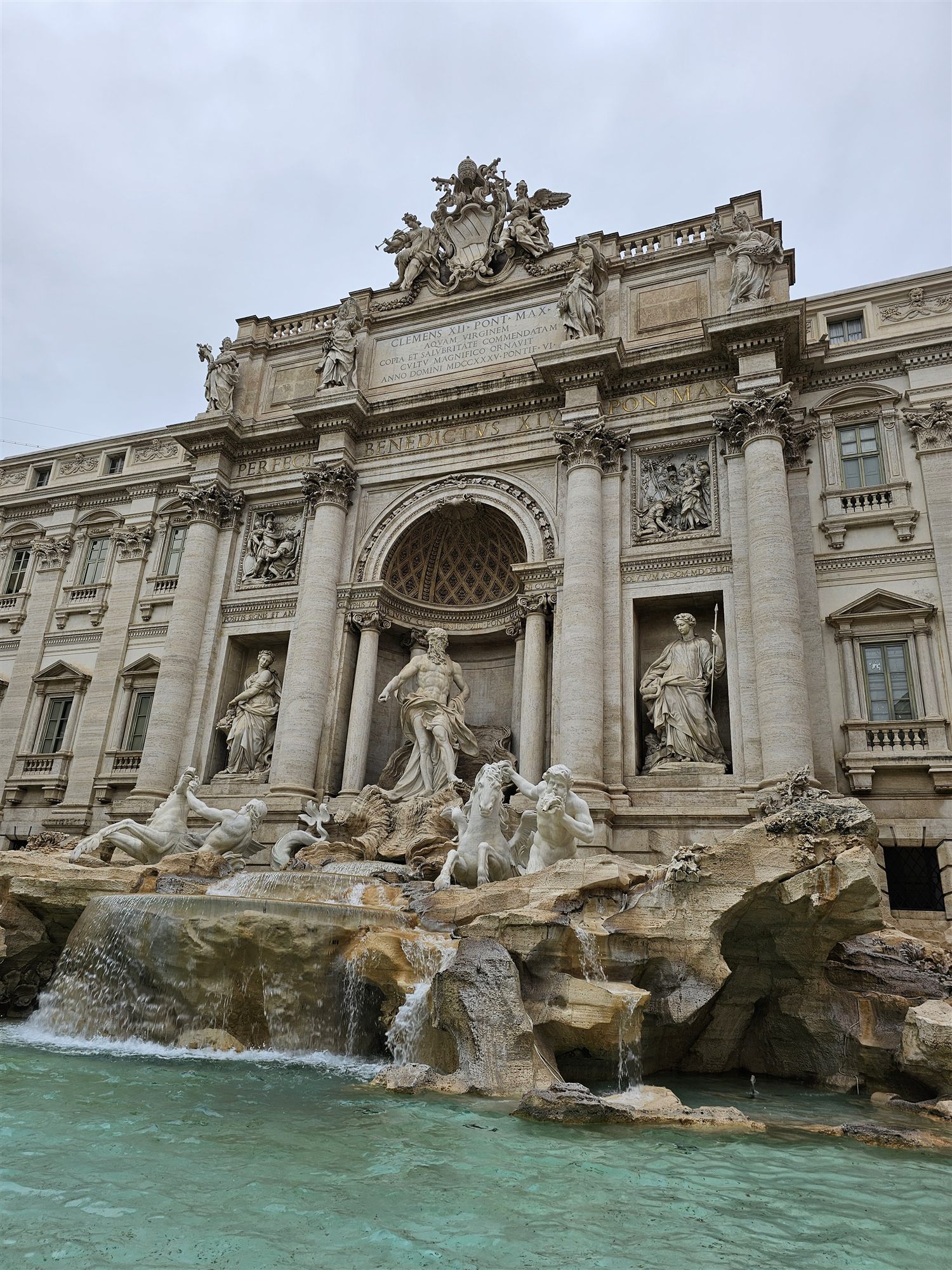 The Trevi Fountain, its facade rising behind the water.
 A gelato in hand at the Trevi, the first stop of the morning.
The Pantheon's 2,000-Year-Old Dome
From the Trevi Fountain it's a short walk to the Pantheon, and the two make an easy pairing on a single afternoon. The Pantheon was built around 113–125 AD under Emperor Hadrian and still holds the record for the world's largest unreinforced concrete dome — nobody has built one bigger without steel reinforcement since. The only light comes from the oculus, a nine-metre opening at the top of the dome that's open straight to the sky. It rains directly onto the marble floor, which is why the floor is subtly sloped with drainage holes built into it two thousand years ago. It's also a working church and the burial site of the painter Raphael, so keep voices down inside.

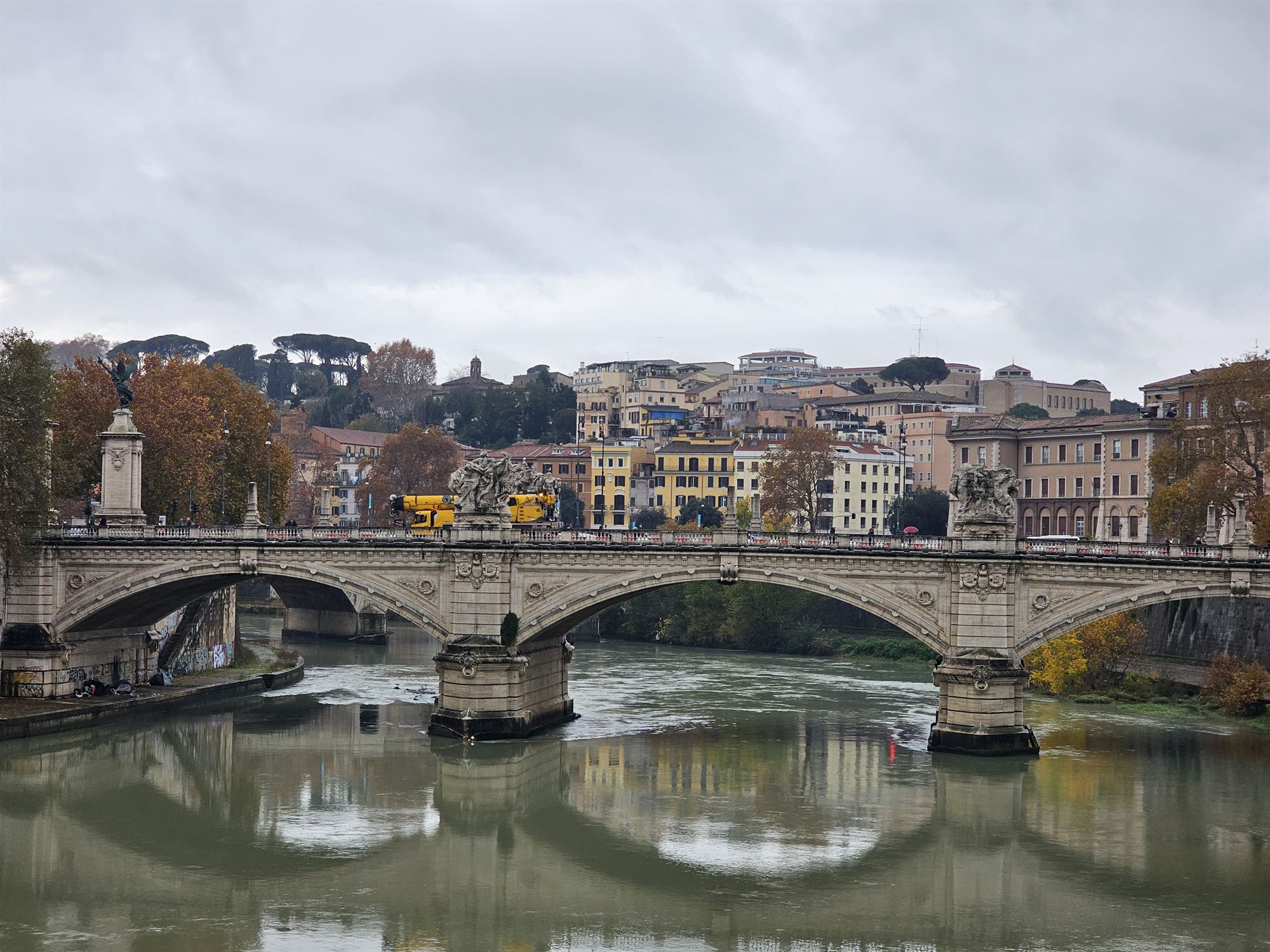
On the way between the two, we crossed one of the bridges over the Tiber, with statues watching the traffic go by. We were in no hurry, and the walk was the first real sense of the city for us.
Pizza Before the Vatican
By lunchtime we were hungry, and we stopped for pizza before heading to the Vatican. It was a simple, unhurried meal, a good break before the afternoon's tour.
Book the Vatican Museums as a guided tour with fast-track entry rather than a standalone ticket. Lines for same-day, unbooked entry can run over two hours, and a guide moving your child through the Gallery of Maps and Sistine Chapel with a story attached to each room holds their attention far longer than a self-guided audio tour will.
The Guided Tour of the Vatican Museums
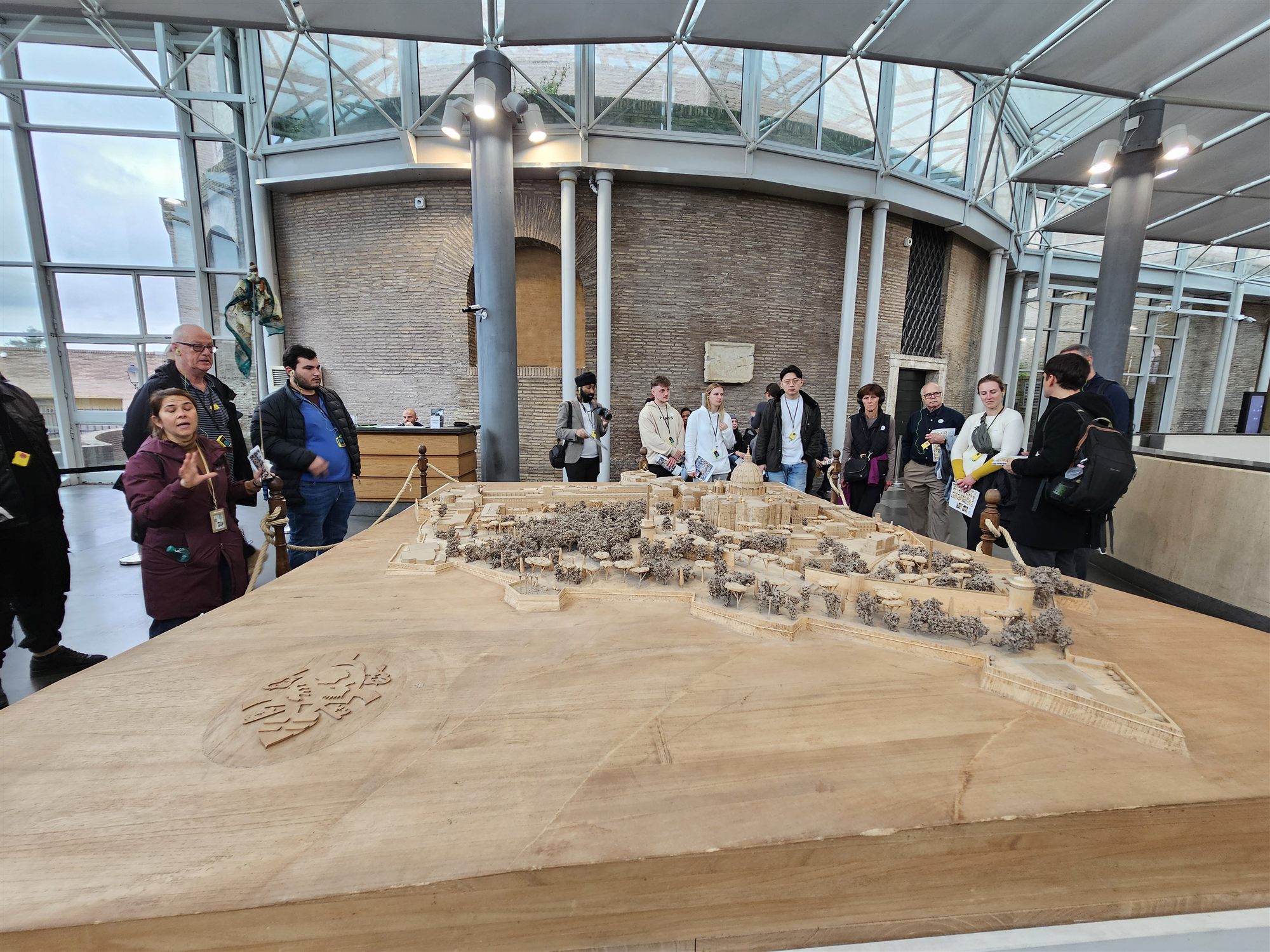
After pizza, we joined a guided group tour of the Vatican Museums — 2.5 to 3 hours with fast-track entrance, covering the museums, the Sistine Chapel and St Peter's Basilica. The Vatican Museums hold roughly 70,000 works, of which only about 20,000 are ever on public display at one time, so a guide's job is really about knowing which 1% to stop at, rather than trying to see all of it, which isn't physically possible in a single visit anyway.
The Raphael Rooms
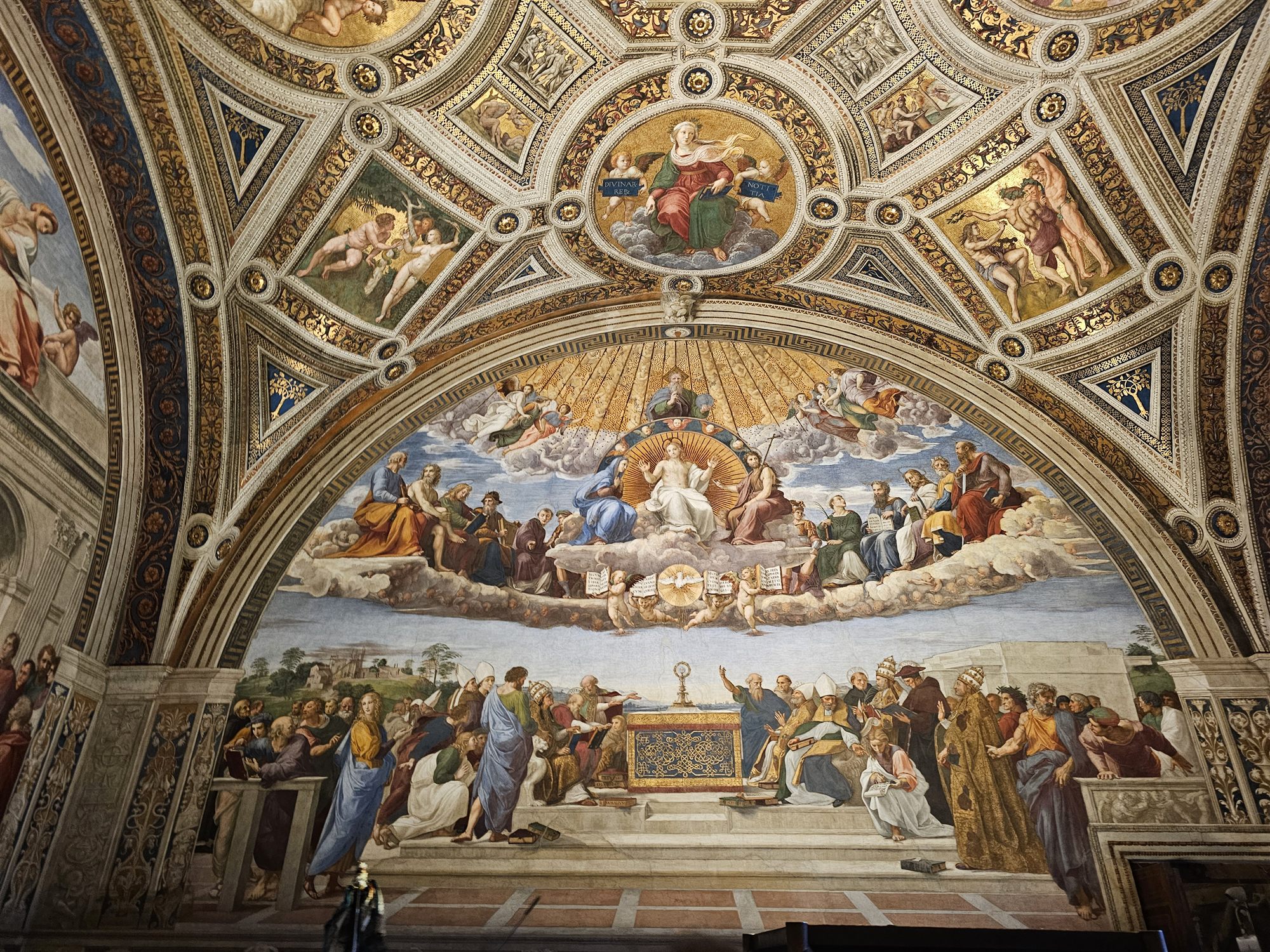
Partway through, the route passes through the Raphael Rooms — four papal apartments that Pope Julius II had frescoed starting in 1508, the same year Michelangelo began the Sistine ceiling next door. Raphael was in his mid-twenties when he started and died before the final room was finished, leaving assistants to complete it from his designs. The most famous fresco here, The School of Athens, packs dozens of classical philosophers into a single painted hall, several of them modelled on Raphael's contemporaries — Plato is widely believed to be a portrait of Leonardo da Vinci.

From there the route continues to the Gallery of Maps, 120 metres long and lined with 40 topographical maps of Italy's regions, painted directly onto the walls in the 1580s under the direction of a Vatican geographer using surveys of the time — long enough a walk that our daughter had counted every ceiling panel by the time we reached the far end.

Ancient Rome, Under One Roof
Long before it became a Christian museum, much of the Vatican's collection was assembled purely as classical antiquities — Greek and Roman sculpture collected by popes for centuries. The octagonal courtyard in the Pio-Clementino Museum holds some of the most significant pieces, including the Laocoön, a dramatic marble group depicting a Trojan priest and his sons being crushed by sea serpents, rediscovered buried in a Roman vineyard in 1506 and identified almost immediately by Michelangelo himself, who was called in to help authenticate it. Reclining river-god statues like the one below, representing the Nile or the Tiber, sit nearby — a reminder that this was Rome's art before it was the Vatican's.

A Breath of Air Before the Sistine Chapel
The Vatican Museums are, honestly, a lot to take in for anyone, let alone an 8-year-old, and the outdoor courtyards between gallery wings turned out to be as useful as any exhibit — a few minutes of open sky and grass before diving back into another wing of marble and gold. The Cortile della Pigna, named for the giant bronze pinecone sculpture at one end, and the lawns near the Braccio Nuovo gave us exactly that kind of pause.

The Sistine Chapel and St Peter's Basilica
The Sistine Chapel is the obvious finale: Michelangelo painted the ceiling between 1508 and 1512, working mostly alone and lying on his back on scaffolding of his own design. No photography is allowed inside, and guards do enforce it, so the image you leave with is whatever you actually looked up and noticed. From there the tour continues directly into St Peter's Basilica, the largest church in the world by interior area, built over the site tradition holds is the tomb of Saint Peter himself, with a dome designed in part by Michelangelo decades after he'd finished the ceiling next door.
 Walking the gilded galleries toward the Sistine Chapel.
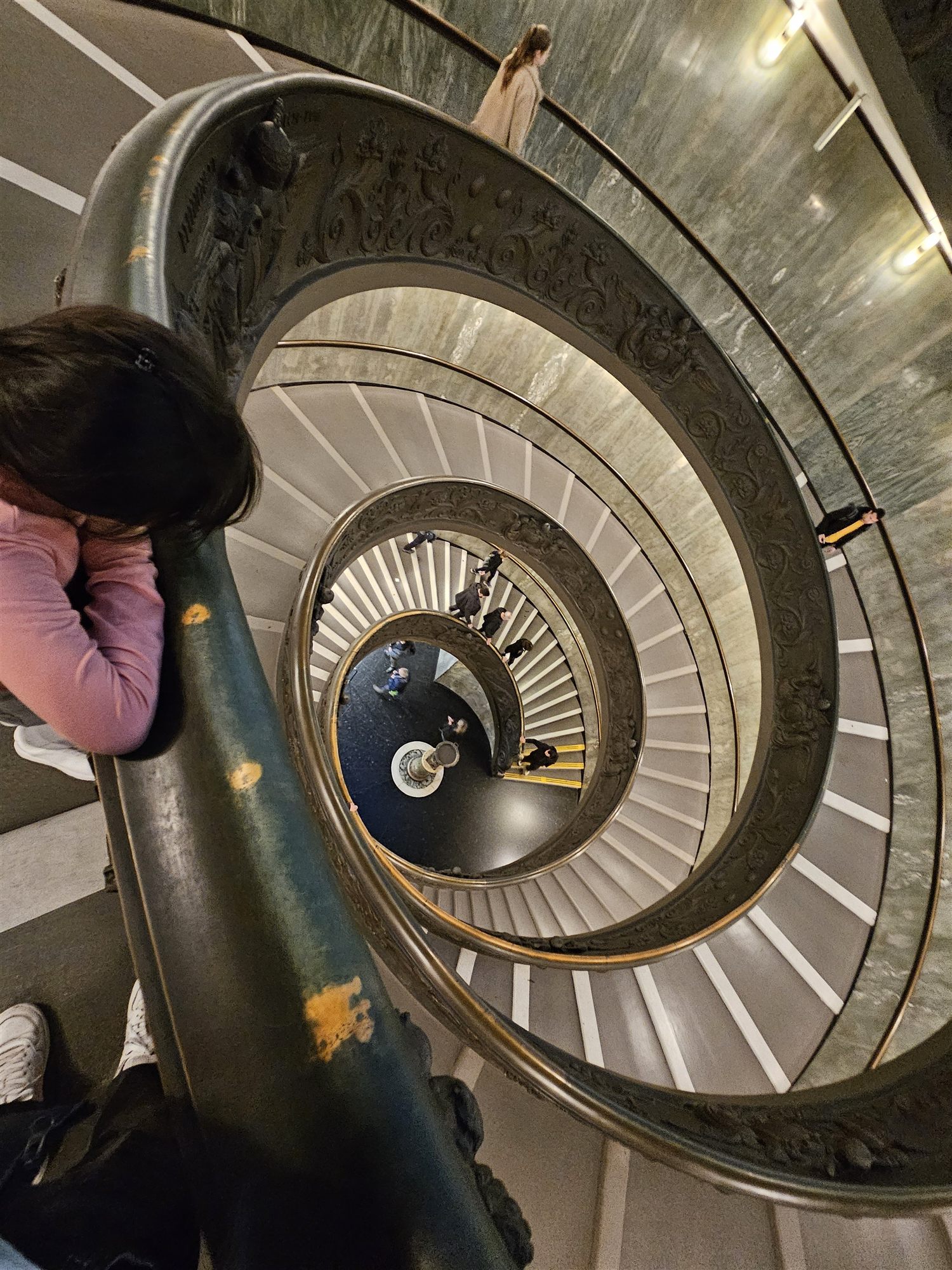 The Bramante Staircase, seen from above.
Wandering Back Between the Landmarks
After the tour, we wandered back toward the hotel with no map and no fixed destination. Rome's historic centre rewards this: the streets between the big landmarks are lined with the same weathered stone and shuttered windows, and you'll stumble onto a small piazza or fountain that isn't in any guidebook.
What Actually Held Her Attention
Our daughter's favourite part wasn't the Sistine Chapel — it was the Gallery of Maps and the spiral Bramante Staircase near the exit, mostly because she wanted to know if it was the same one from a movie she'd seen (it's a similar double-helix design, though the famous spiral staircase is actually the exit ramp, not the entrance). A guided tour makes room for exactly that kind of tangent, which is reason enough on its own to book one over a self-guided ticket.