Quick Facts
- Date
- Friday, 15 December 2023 — Day 5 of 14, the morning after our visit to Pompeii
- Tour
- Full-day guided coach tour from Naples, roughly 9 hours
- Region
- Amalfi Coast, Campania, Italy
- Covers
- Sorrento, Conca dei Marini, Positano, a coastal boat ride, Amalfi Cathedral
- Good for
- A full day, best visited off-peak (winter/quieter season)
Setting Off Along the Amalfi Coast
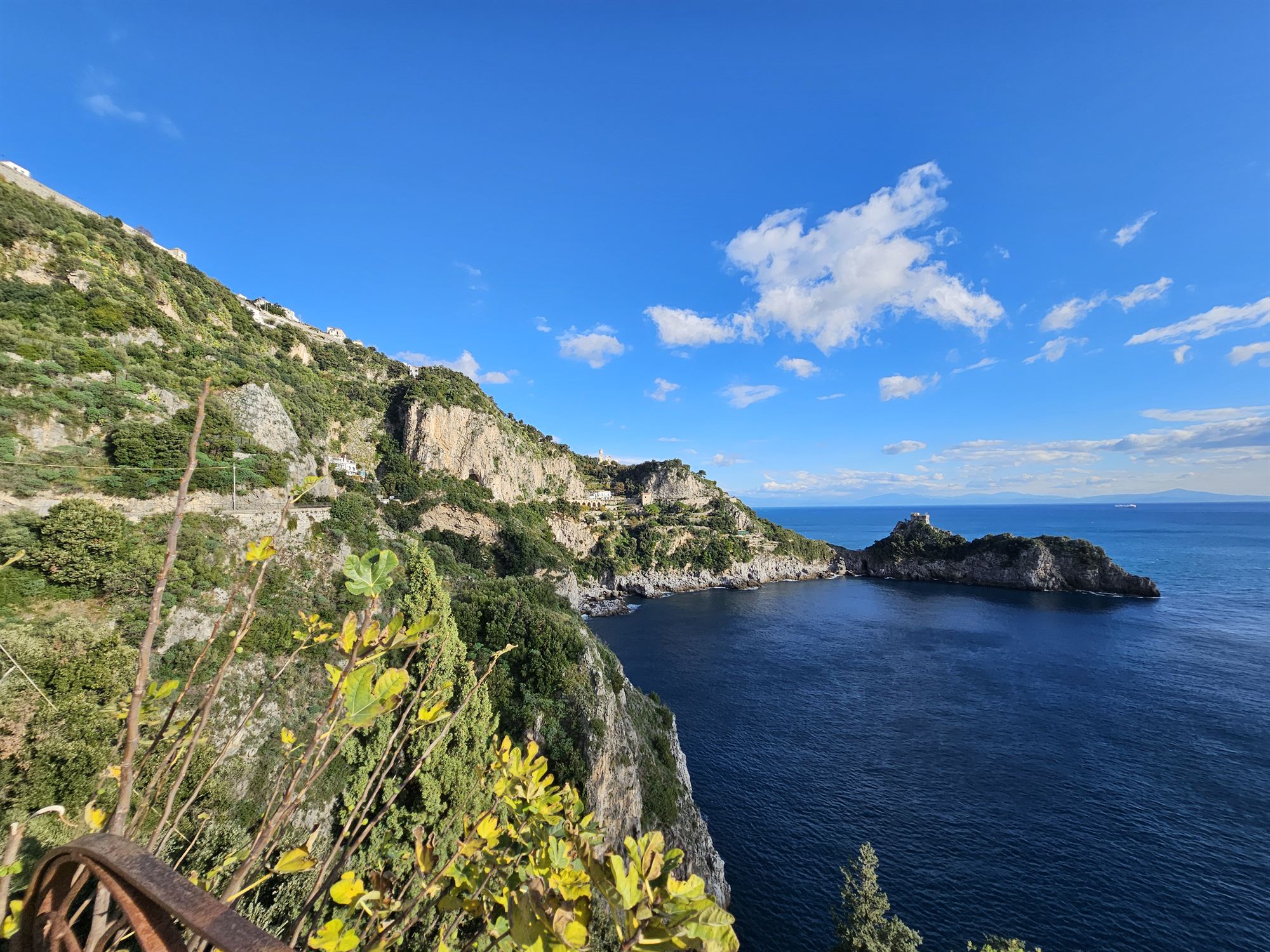
The morning after walking through Pompeii, on 15 December, we joined a full-day guided coach tour from Naples along the Amalfi Coast — roughly nine hours door to door. The drive itself is most of the experience: the coastal road (the SS163, if you're driving it yourself) hairpins along cliff edges the entire way, with the sea opening up on one side and pastel-coloured towns stacked into the hillside on the other.

A Stop in Sorrento
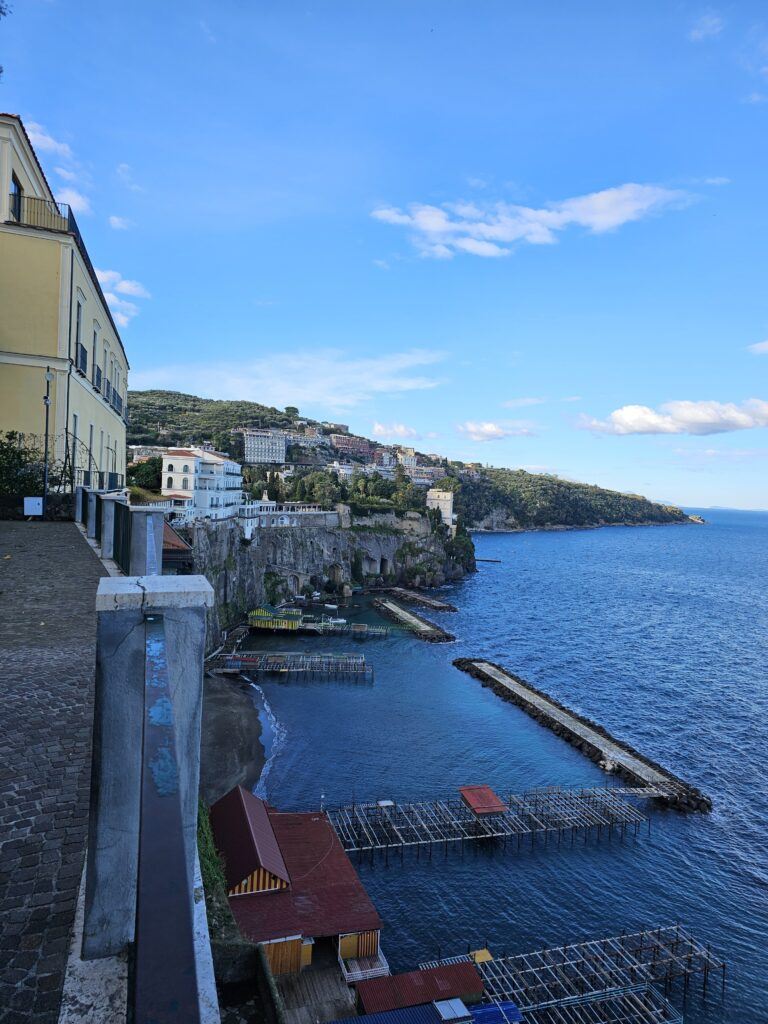
Our first stop was Sorrento, a town built on a clifftop overlooking the Bay of Naples, with Mount Vesuvius visible across the water on a clear day — the same volcano we'd just walked past the ruins of a day earlier. The town's name is thought to derive from the ancient Greek Sirenusae, after the Sirens of Homer's Odyssey, said to have lured sailors onto these very cliffs with their singing. Sorrento is also the town behind "Torna a Surriento," the Neapolitan song written in 1902 for a visiting Italian prime minister and later recorded by everyone from Enrico Caruso to Elvis Presley — you'll hear a version of it drifting out of at least one café no matter what time of year you visit.
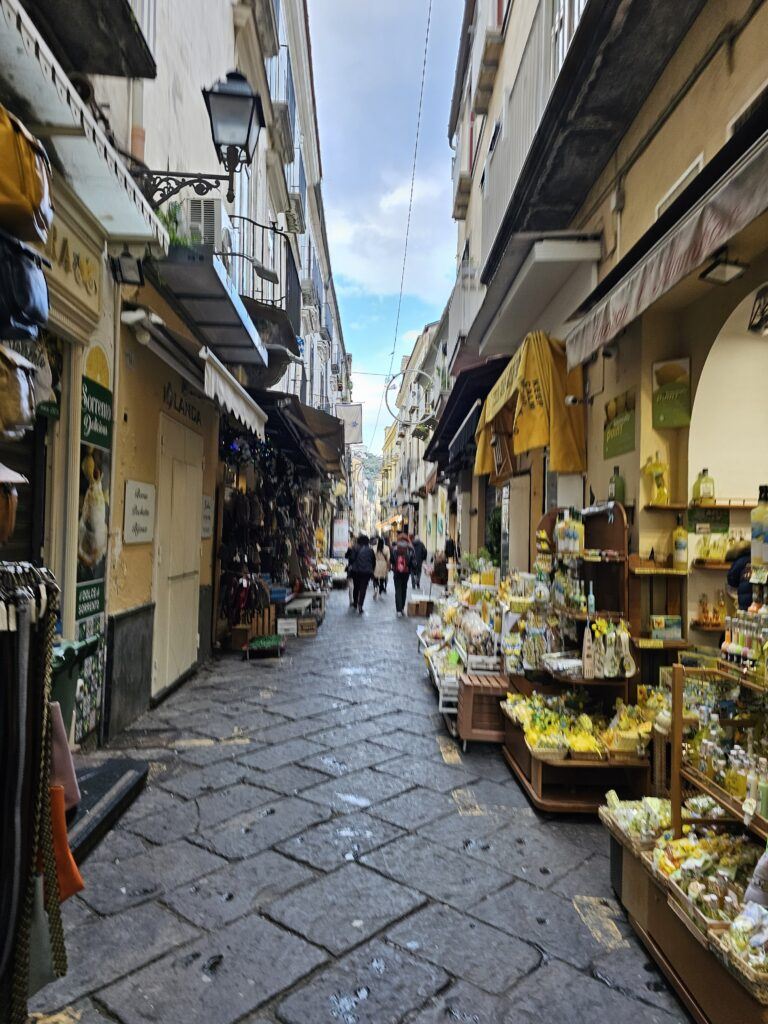
Sorrento is known for its lemon groves, and the fruit shows up everywhere: in the shopfronts, in the limoncello sold by the bottle, in the gelato. The town is also famous for intarsio, an intricate wood-inlay craft using different natural wood tones to "paint" scenes without any dye, a tradition here since the 1800s. We spent our stop wandering the small streets rather than shopping for any of it, which suited the pace of the morning fine.

Lunch at Conca dei Marini
Back on the coastal road, the scenery kept shifting around every bend — cliffs, pastel houses, the sea in a deeper blue than it has any business being in December. We stopped for lunch at Conca dei Marini, a small fishing village between Amalfi and Positano, best known for the Emerald Grotto, a sea cave discovered by a local fisherman in 1932 and named for the way sunlight filters through an underwater opening and lights the whole cavern a glowing emerald green. Lunch was simple: a plate of pasta, a glass of local white wine, the sea directly in front of the table. Nothing about it needed to be more complicated than that.
Positano
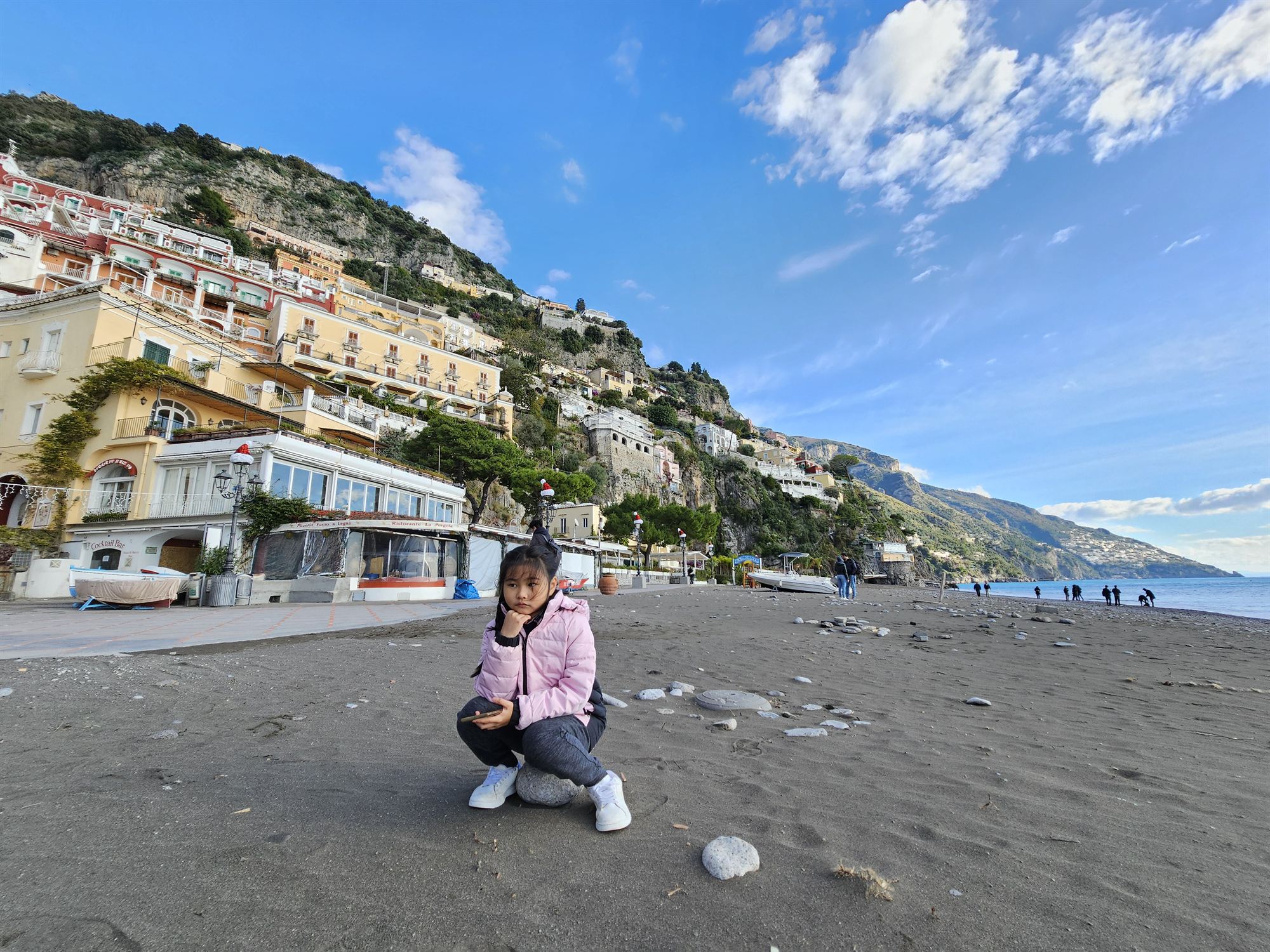
Positano came next, and it's the one stop on this coast that looks most like its photographs — houses in yellow, pink and white cascading down a near-vertical hillside to a small beach. It was a sleepy fishing village until the American writer John Steinbeck spent time here in 1953 and wrote an essay about it for Harper's Bazaar that's often credited with putting the town on the international map almost overnight. The town has no flat ground to speak of; every street is either a staircase or close to one, which is worth knowing if you're travelling with a stroller or bad knees.

Down to the Water
We walked down toward the shore through Positano's narrow, stepped lanes. Visiting in December meant a fair number of shops were shuttered for the off-season, but it also meant no crowds — we had stretches of the path to ourselves that would be packed solid in July. At the beach, our daughter spent a good stretch of time just moving pebbles around while we sat and watched the water.
Along one of the lanes we stopped at a small stall selling original paintings by a local artist and bought a small piece — partly as a souvenir that wasn't a magnet or a keychain, and partly because tourism drops off hard here in winter, and a sale probably meant more to that artist in December than it would in August.
Visit the Amalfi Coast in the off-season if your schedule allows it. Summer traffic on the coastal road can turn a 90-minute drive into three hours, and Positano's lanes get packed. In December we had space to actually stop and let a child explore, which isn't really possible here from June through August.
Seeing the Coast from the Water
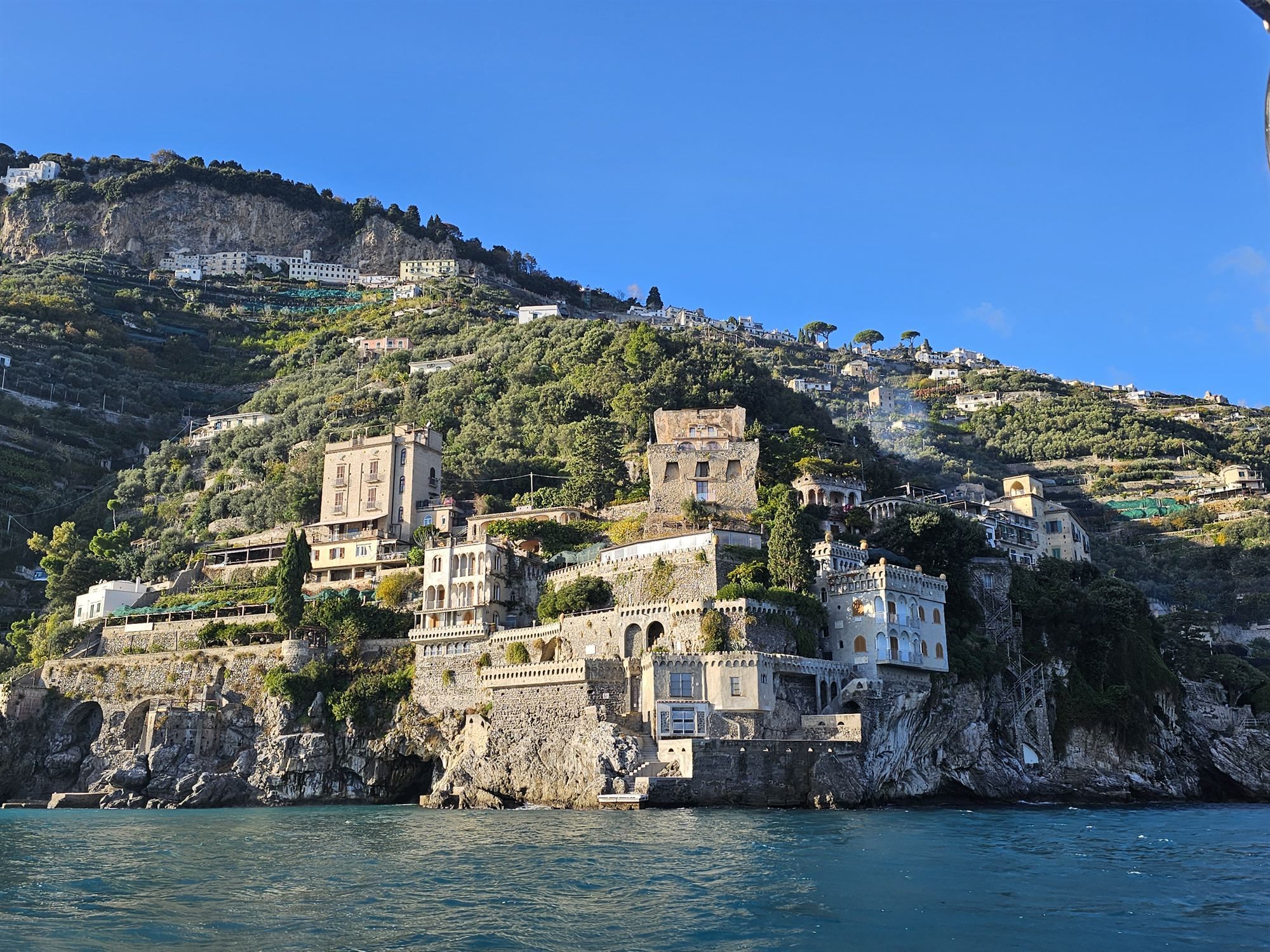
Part of the day included a short boat ride along the coastline, which changes the whole picture — from the water, you can see just how much of this coast is built vertically, with houses stacked five and six storeys up a cliff face that has no business supporting a town. It's a different, better view of the coastline than anything from the road.

Amalfi Cathedral
Our last stop was the town of Amalfi itself, once the seat of one of Italy's four historic maritime republics, alongside Venice, Genoa and Pisa, with its own fleet, currency, and maritime code, the Tavole Amalfitane, that helped govern trade across the Mediterranean for centuries. The Amalfi Cathedral (the Duomo di Sant'Andrea) sits at the top of a broad staircase dating back to the 9th century, with a distinctly Arab-Norman facade that reflects that trading history. Its crypt holds relics said to be those of St. Andrew the Apostle, brought here from Constantinople in 1208 during the Fourth Crusade.
We sat on the steps in the afternoon sun for a while before the walk back to the bus — a good place to stop moving for ten minutes.
 The Amalfi Cathedral, its bell tower and mosaic facade above the town square.
 Father and daughter on the cathedral steps.
Back to Naples
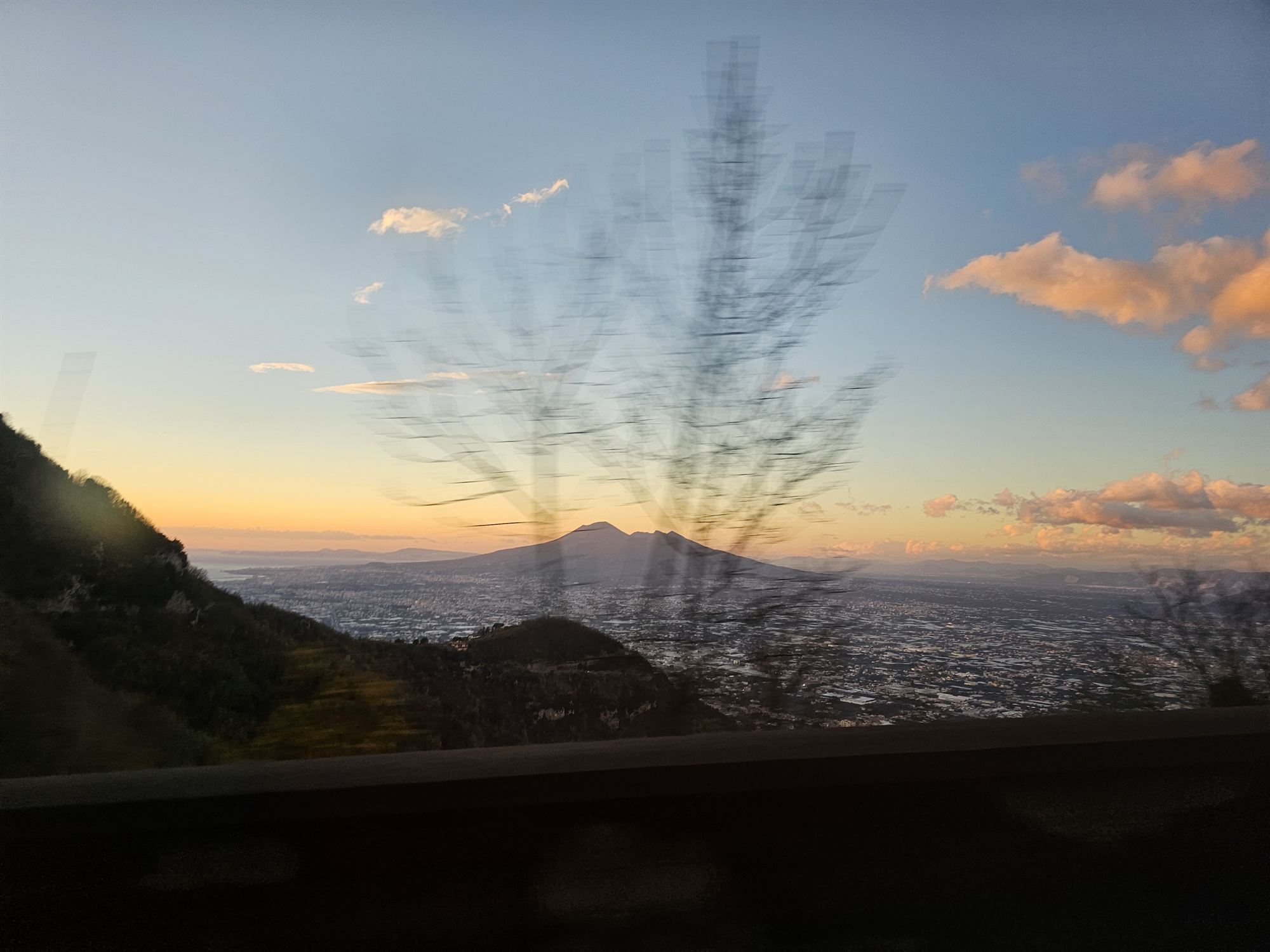
The tour wrapped up around 4pm, and the bus brought us back into Naples as the light was fading, Vesuvius silhouetted against the sunset the whole way down. After a sobering morning the day before among Pompeii's ruins, a day spent on a coastline built entirely on defying gravity made a strong contrast — and worth the early start it demands.