
Quick Facts
- Date
- Thursday, 14 December 2023 — Day 4 of 14, the same day as our train from Rome to Naples
- Tour
- Guided walking tour, about 3 hours, booked as part of a private family package
- Region
- Pompeii, Campania, Italy — about 25 minutes from Naples by train
- Covers
- The Forum, main streets, a decorated villa, the plaster casts, the Large Theatre
- Good for
- A guided visit — there's almost no on-site signage, so context makes or breaks it
A City Buried in Under a Day
We took the train from Rome to Naples on the morning of 14 December, and by early afternoon we were walking through Pompeii with a guide. Pompeii was an ordinary, busy Roman town of roughly 11,000 people until Mount Vesuvius erupted in 79 AD, burying it under several metres of ash and pumice within about a day. The speed of it is what stays with you: shops still held goods on their shelves, bread was left in the ovens, and graffiti scratched into the walls by idle teenagers survived intact.
The ash kept the city largely undisturbed for close to 1,700 years, until systematic excavation began in the 1740s. Pompeii is now a UNESCO World Heritage Site, and its appeal lies in the everyday life it preserved, not only in its temples and monuments.

The Forum's Colonnades
The tour began at the Forum, the civic heart of Pompeii, where temples, market halls and government buildings once faced one another across an open square. Its rows of Doric columns still run along the edges, and the lawns between them give the site a calm that is hard to expect from a place this old.
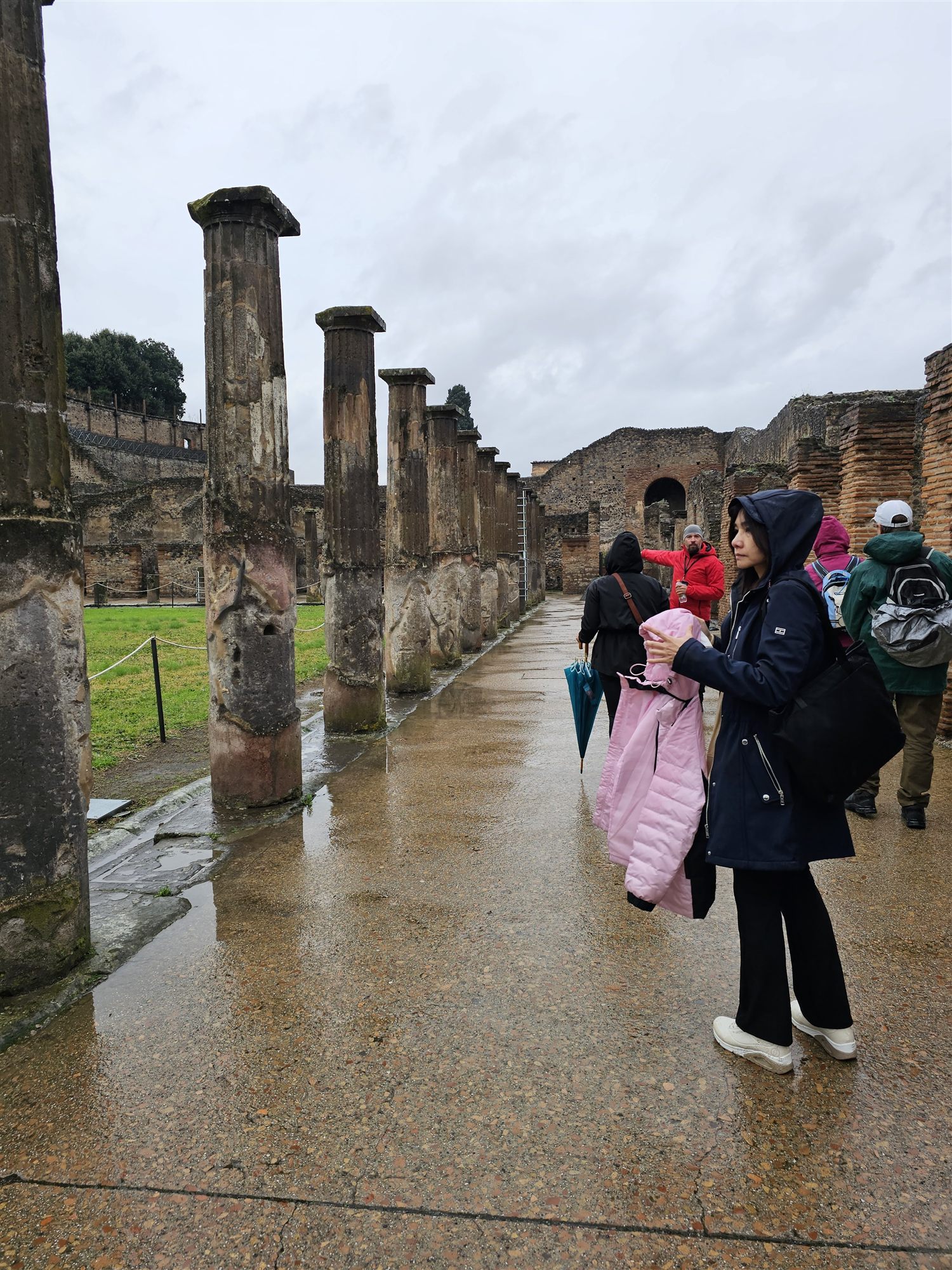 Doric columns along the edge of the Forum, with the lawn beyond.
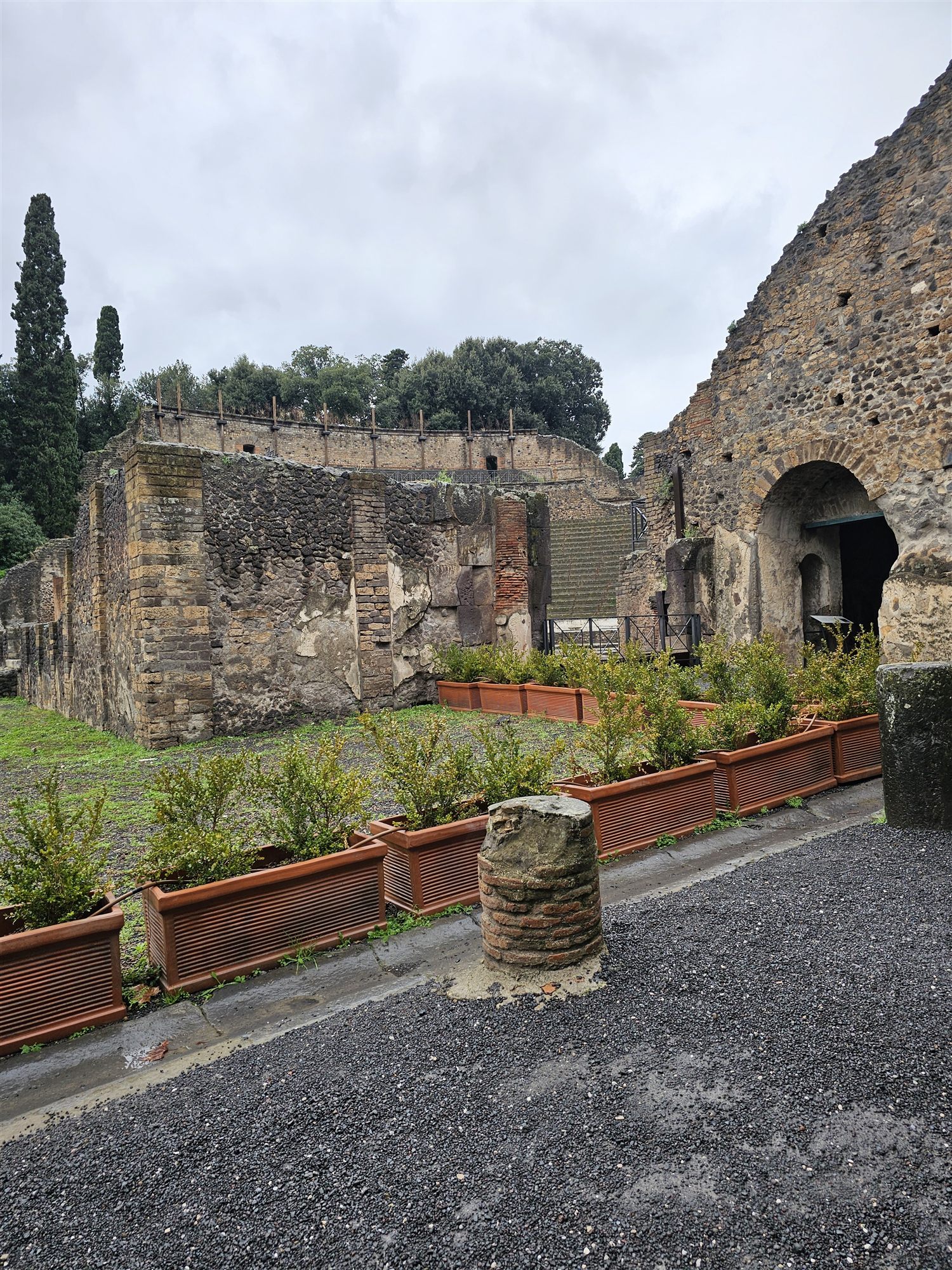 Clipped hedges in terracotta planters, set against the old walls.
Hedges Between the Walls
Between the excavated houses, the modern gardeners have kept planted hedges in terracotta boxes, set against walls that are two thousand years old. The contrast is quiet but striking: living green in the same spaces where daily life once went on.
The Amphitheatre
The amphitheatre, built around 70 BC, is the oldest surviving stone amphitheatre in the Roman world. It could seat around 20,000 spectators, and it hosted gladiatorial contests. In 59 AD, according to the historian Tacitus, a brawl between Pompeian and Nucerian crowds turned into a riot, and the games were banned here for ten years. Walking down the steep tiers toward the arena, it is easy to picture that noise.
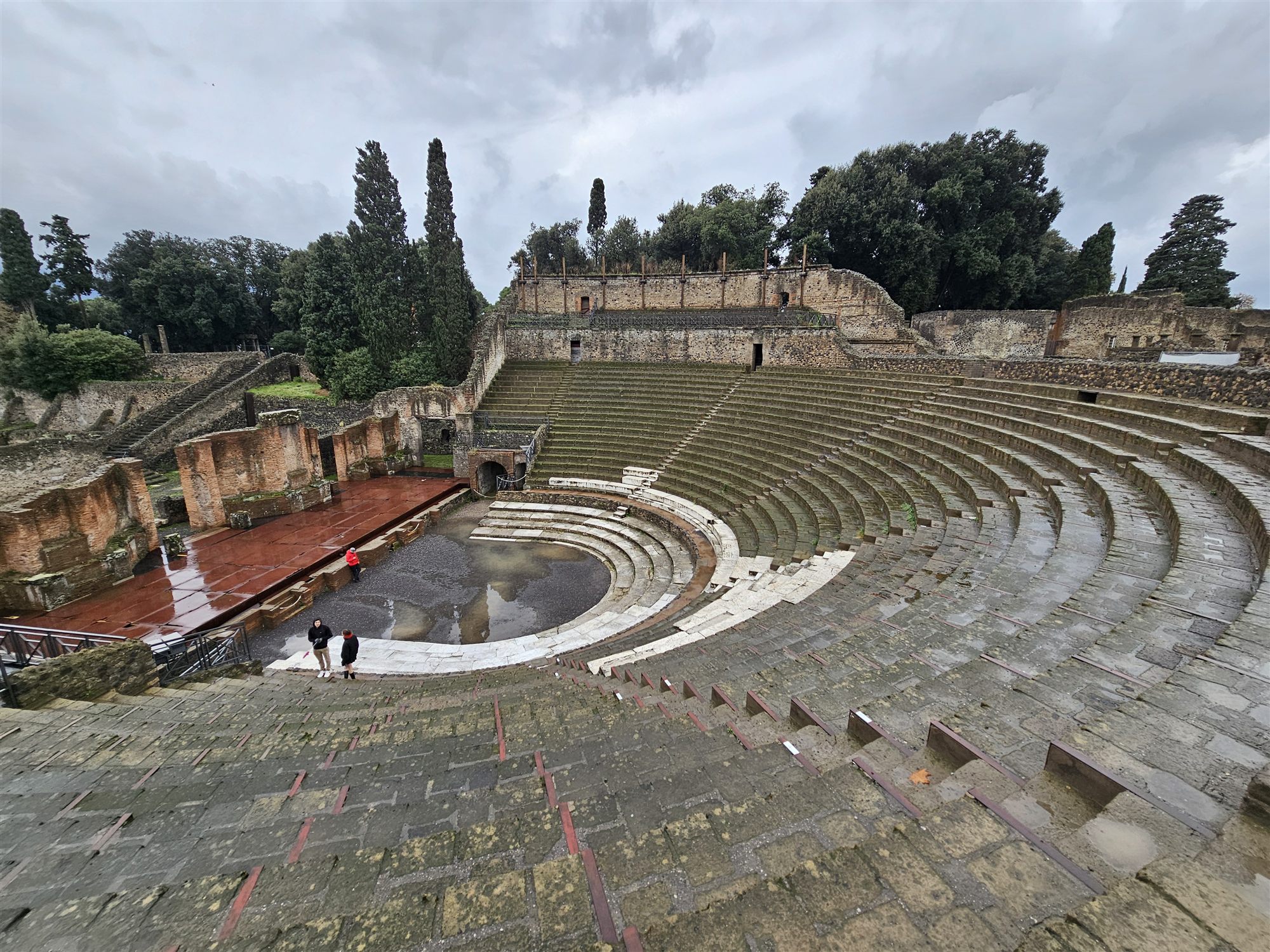
Above the Excavations
From the walls and raised paths, the excavated city opens up in every direction. Beyond the ruins, a white church stands on the hillside of the modern town. The view makes clear how much of Pompeii is still buried under the fields and houses beyond the walls.
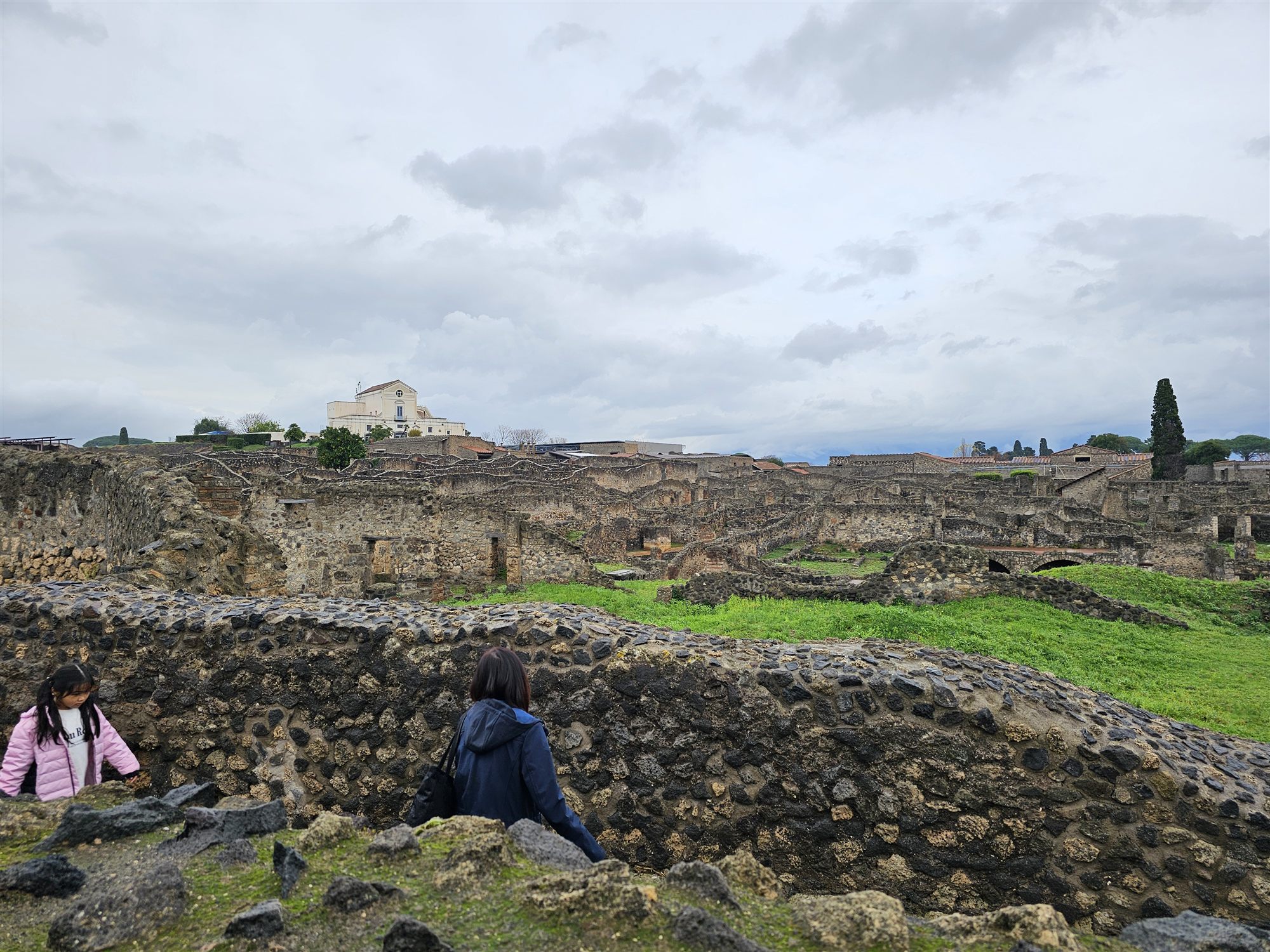
Walking the Original Roman Streets
What sets Pompeii apart from most ruins is how ordinary it still feels at street level. You are walking on the paving stones themselves, with chariot-wheel ruts worn into the road and raised stepping stones at each crossing, placed so pedestrians could cross without wading through the sewage that ran down the middle of the street. The street signs follow the Roman system of regions and blocks, so a sign reading "Reg III, Ins III" marks the third region and the third block.
 The cobbles, worn smooth by two thousand years of traffic.
 A narrower lane, signed Reg I, Ins IV, with its raised pavement.
The Plaster Casts
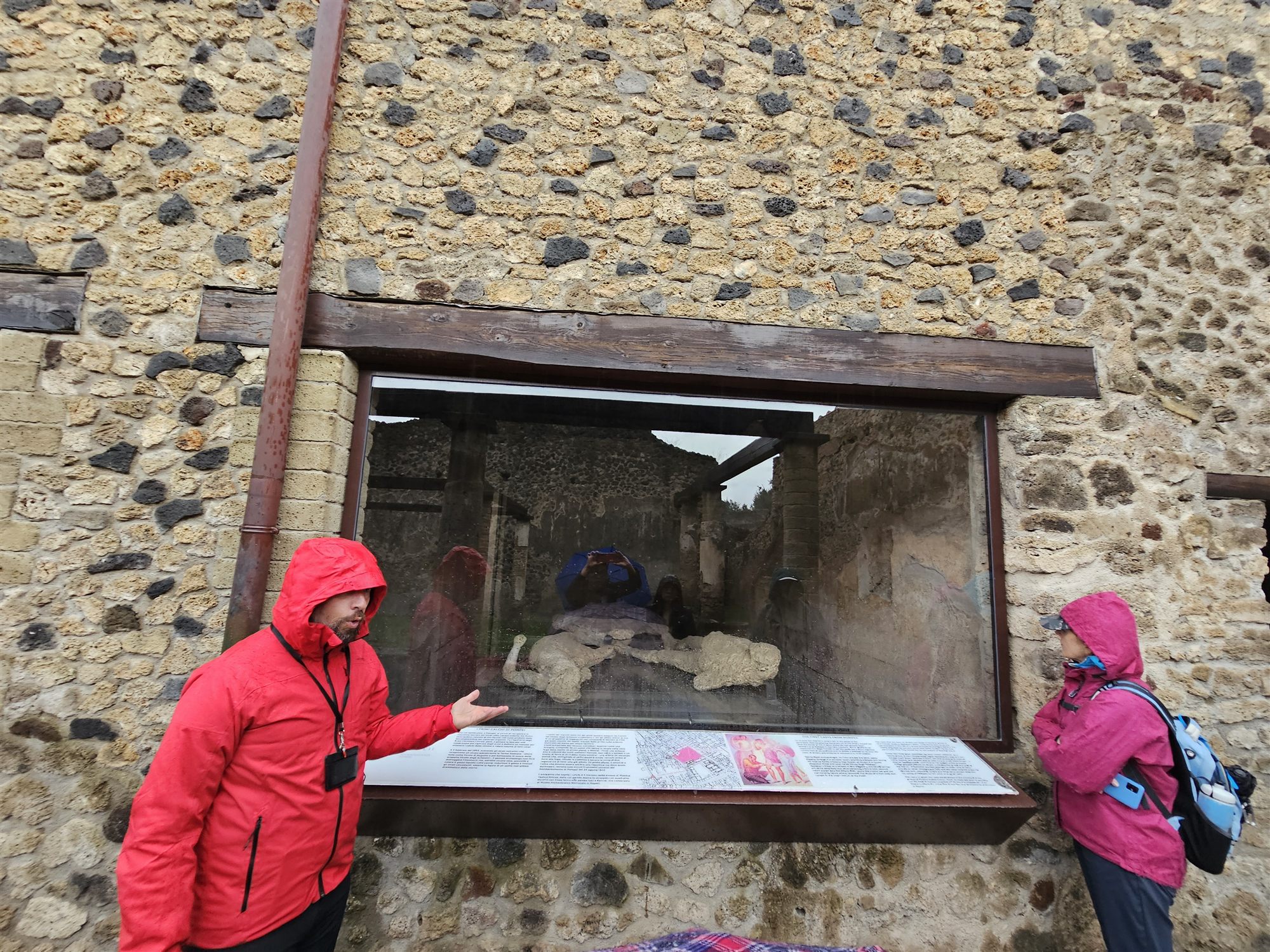
The plaster body casts are the detail most people associate with Pompeii, and it helps to know what they are before you see one with children. As victims died in the ash, their bodies decayed, leaving cavities in the hardened volcanic material that kept their final shapes. In 1863 the archaeologist Giuseppe Fiorelli found that these voids could be filled with plaster to recreate the forms of the people who had lain there. Our guide handled this part carefully and plainly, and it was more thought-provoking than frightening, even for an 8-year-old.
Painted Rooms Still Intact
In one of the better-preserved houses, whole rooms of wall paintings survive in something close to their original colour. Their style is what art historians call Second Style Roman wall painting: illusionistic architecture, panels and mythological scenes, painted directly onto wet plaster so that the pigment became part of the wall itself. Standing inside a fully decorated reception room, with its roof timbers still overhead, is a different experience from seeing the same style behind glass in a museum.

Pompeii's streets are uneven volcanic stone with almost no shade, and there is little on-site signage explaining what you are looking at. A guided tour is worth its cost here. Without one, a 2,000-year-old bakery looks like a pile of bricks.
The Forum, With Vesuvius Still Watching
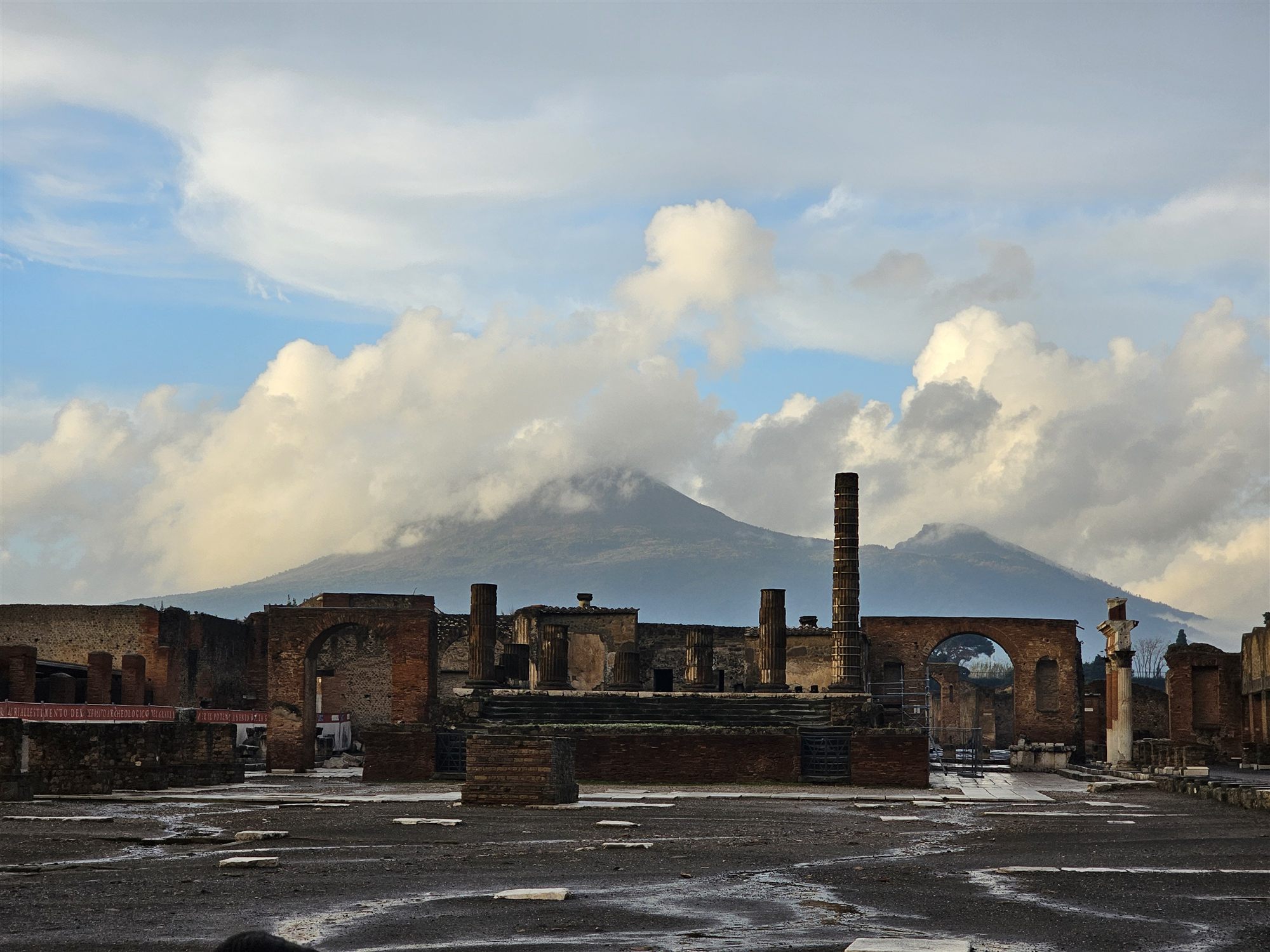
The tour ended back at the Forum, where Vesuvius sits on the skyline, close enough to be unsettling once you know what it did. It remains an active volcano, and its last major eruption was in 1944.
More Than a Disaster Site
By the end of the afternoon, the eruption mattered less to us than how much ordinary life it had frozen in place: gardens, shop counters, hedge-lined courtyards that still look tended rather than excavated. It is easy to arrive expecting a memorial and leave having spent an afternoon in a Roman neighbourhood.
Planning Your Own Visit
Pompeii is an easy day trip from Naples by train, but treat the three-hour guided tour as a minimum rather than the full visit — the excavated site covers roughly 44 hectares, and most tours only cover a fraction of it. Book a guide rather than going self-directed, wear shoes you don't mind wrecking on volcanic gravel, and bring water regardless of season. If you're combining it with the Amalfi Coast the next day, as we did, expect it to be the more sobering of the two — and worth doing first.