
Quick Facts
- Date
- Thursday, 29 December 2022 — Day 4 in Paris
- Region
- Central Paris, France
- Covers
- Arc de Triomphe viewing platform, the Louvre Museum
- Good for
- A full day — the Louvre alone deserves several hours
Morning Above Paris
With Napoleon and French history still lingering in our thoughts from the previous day, we started our morning at the Arc de Triomphe. Napoleon commissioned it in 1806 to honour his armies, but he never saw it finished — it wasn't completed until 1836, fifteen years after his death, under architect Jean Chalgrin's design. Every surface is covered with carved reliefs and the names of French victories and generals, and since 1921 the arch has also sheltered the Tomb of the Unknown Soldier, its flame relit every evening at 6:30pm without fail, even during the German occupation of Paris in the Second World War.

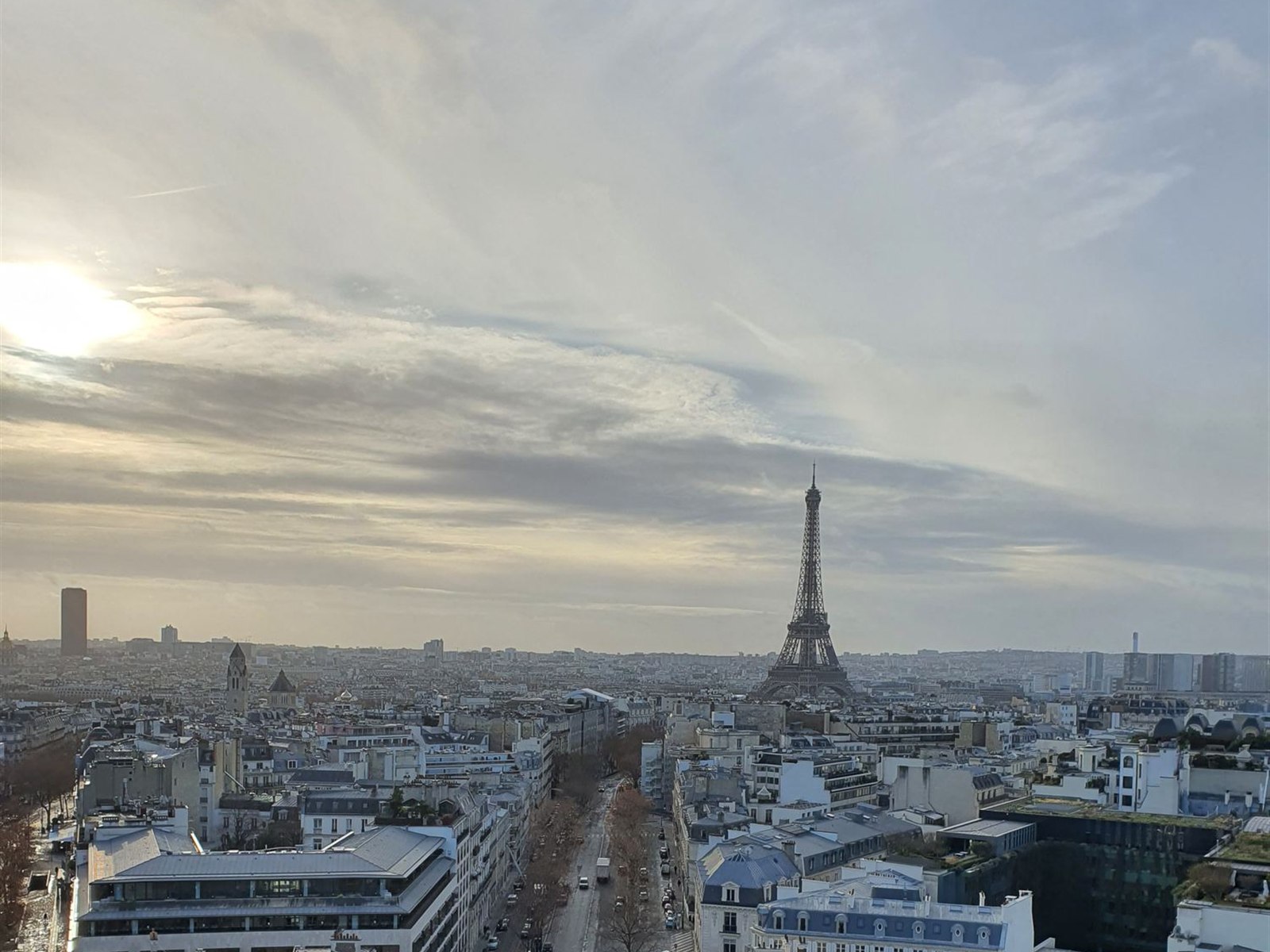
We climbed the 284 steps to the viewing platform at the top — there's no lift — and Paris unfolded around us. The arch sits at the centre of Place Charles de Gaulle, where twelve grand avenues radiate outward like the points of a star, a layout that's part of Baron Haussmann's 19th-century redesign of the city. From up there, the Champs-Élysées runs one way and the Eiffel Tower rises in the distance the other, the whole city laid out with a precision you can't fully appreciate from street level.
Entering the Louvre
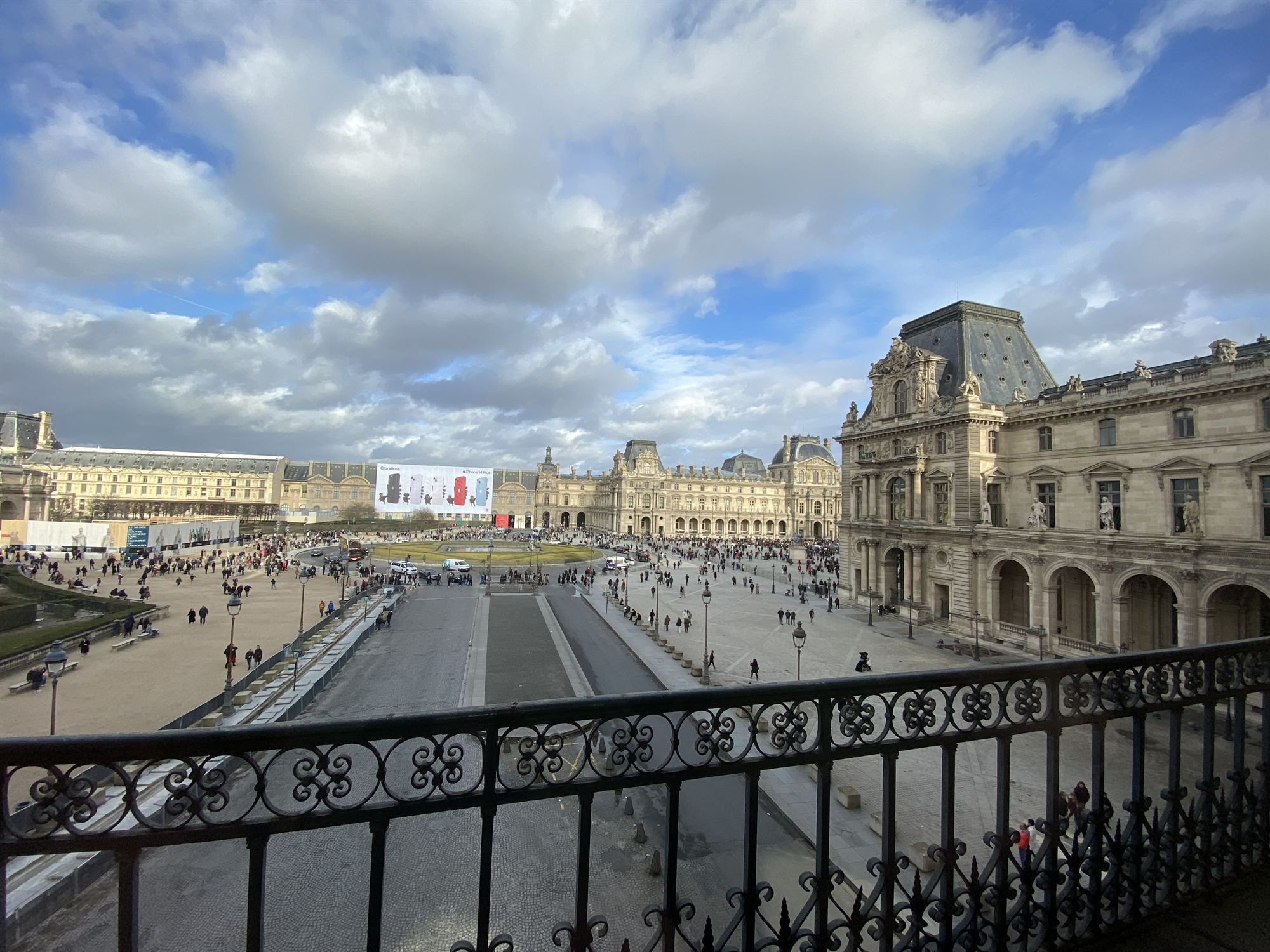
By afternoon, we made our way to the Louvre. Before it was a museum, it was a fortress — construction began under King Philip II around 1190 — and later a royal palace, before the Revolution turned it into a public museum in 1793. The glass pyramid everyone photographs is a much newer addition: designed by the architect I. M. Pei and completed in 1989 as part of President François Mitterrand's renovation of the museum, built from 673 glass panes and initially controversial for how starkly modern it looked against the historic palace around it.
Surrounded by Masterpieces
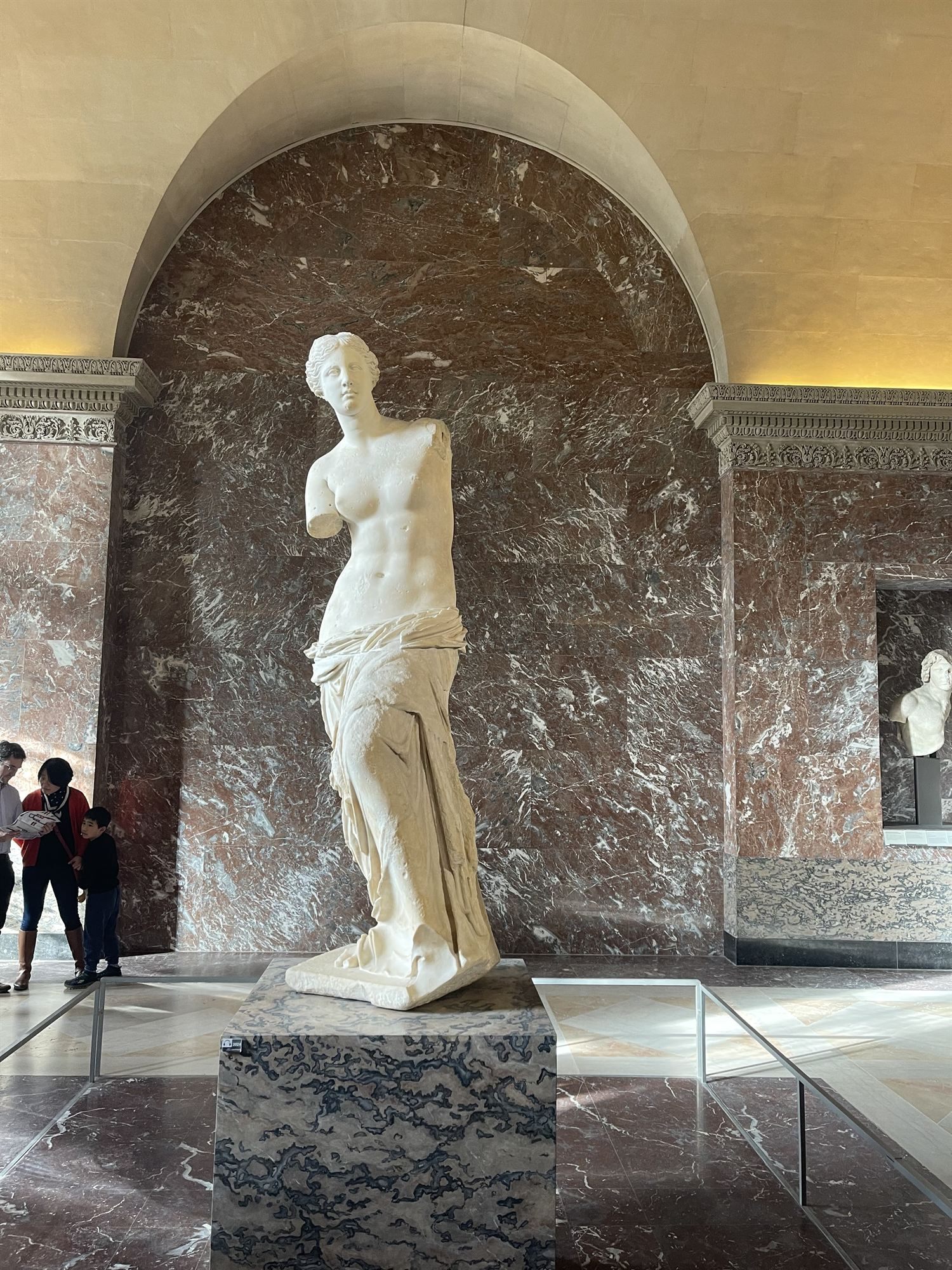
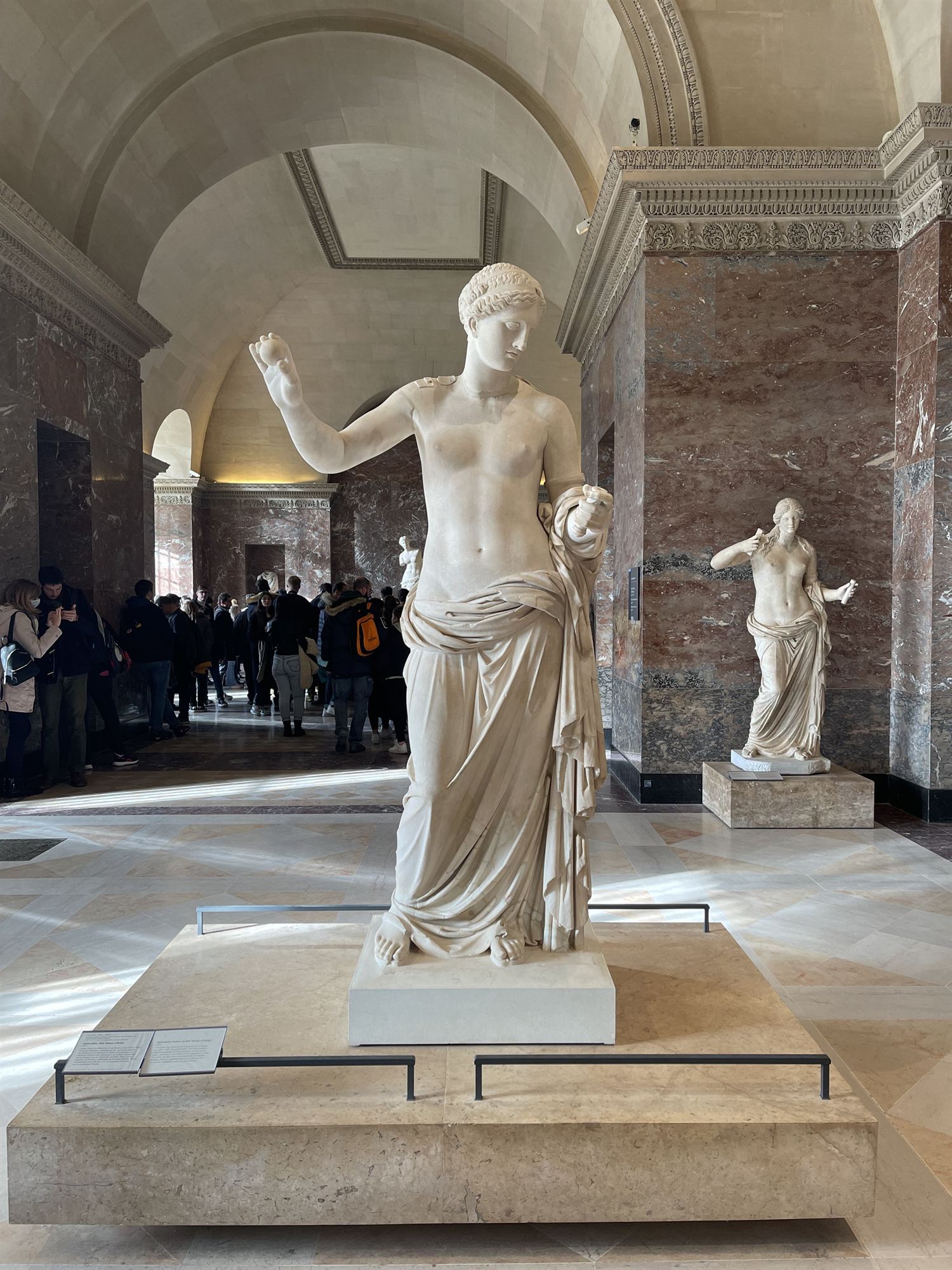
We spent hours wandering slowly through the galleries. The sculptures especially held our attention: the Winged Victory of Samothrace, a headless, armless goddess frozen mid-flight at the top of a grand staircase, was carved around 190 BC and only rediscovered on the Greek island of Samothrace in 1863. Nearby, the Venus de Milo — found on the island of Milos in 1820, missing both arms even then — has become one of the most recognisable sculptures in the world despite (or maybe because of) what's missing from it. The Louvre's Greek and Roman galleries hold dozens more figures like her close by, each with its own centuries-old story.

Even the ceilings were their own exhibit. In the Galerie d'Apollon, begun under Louis XIV in the 1660s and finished two centuries later with a central ceiling painting by Eugène Delacroix, gold leaf and painted panels stretch the full length of the room — and it's here, rather than in a simple display case, that the French Crown Jewels are kept.
Don't try to see the whole Louvre in one visit — pick a handful of must-sees (we chose the Mona Lisa, the jewellery gallery, and the sculpture halls) and let the rest be unplanned wandering. Trying to cover everything with kids in tow leads to burnout fast.
Finally Seeing the Mona Lisa
One of the biggest moments of the day was finally seeing the Mona Lisa. Painted by Leonardo da Vinci sometime between 1503 and 1519, it's smaller in person than most people expect — just 77 by 53 centimetres — and sits behind bulletproof glass, a precaution added after a series of attacks on the painting over the decades. Part of its enormous fame actually traces back to a theft: in 1911, an Italian handyman named Vincenzo Peruggia walked out of the Louvre with it hidden under his coat, and the two years it spent missing (it turned up in Florence in 1913) turned it from a well-regarded painting into arguably the most famous artwork on Earth.

Getting there means walking through the Grande Galerie, a hallway that runs for over 460 metres along the Seine — one of the longest gallery spaces in any museum in the world, originally built to connect the Louvre to the since-demolished Tuileries Palace.
 Resting on the benches beneath the large paintings.
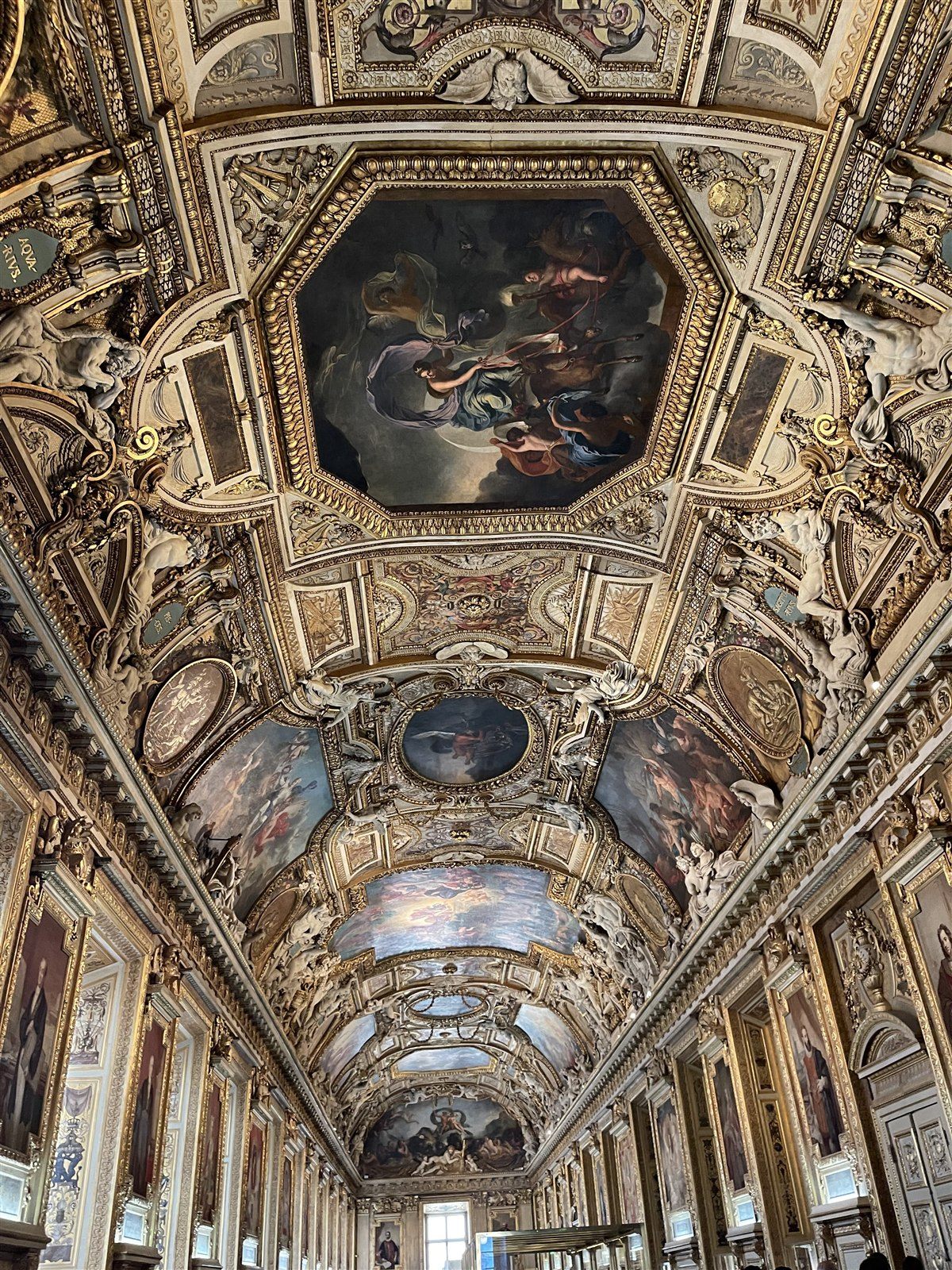 The ornate ceiling overhead, painted and gilded throughout.
Napoleon's Jewellery and Royal Treasures
One section that completely captivated us was the jewellery gallery. Behind the glass displays were crowns, tiaras, gemstones set in gold, and objects that once belonged to French and European royalty. We were especially struck by a set of emerald jewellery — a necklace and earrings, part of a larger set that once included a diadem and comb — that Napoleon gave to his second wife, Marie Louise of Austria, for their wedding in 1810. It was made by François-Régnault Nitot, the imperial court's official jeweller. Because the set wasn't officially part of the French Crown Jewels, it passed down through Marie Louise's own family after her death in 1847, eventually landing with the Habsburg line that ruled Tuscany, before finding its way back to the Louvre.
 The emerald and diamond necklace, with a crown in the case behind it.
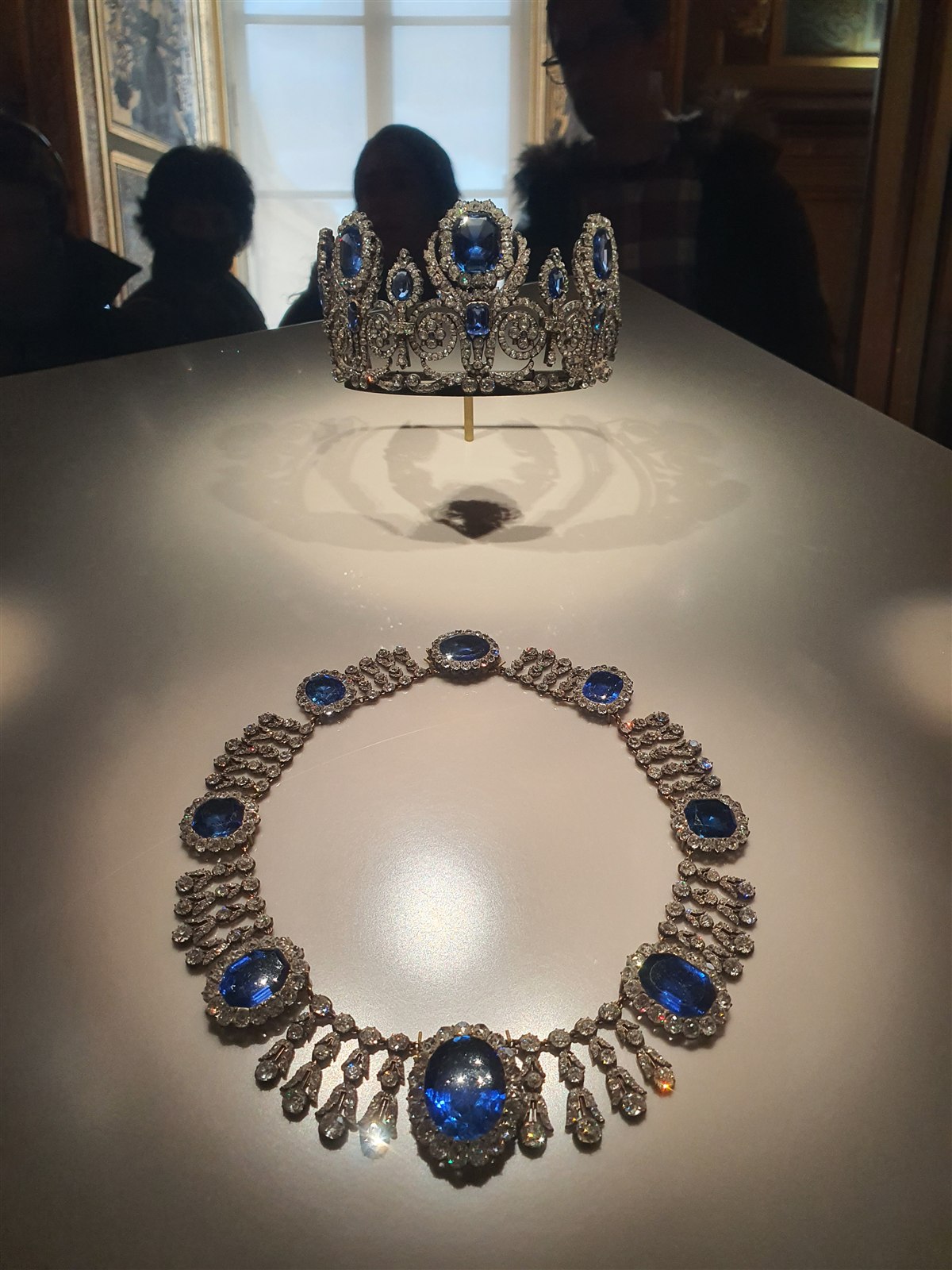 A sapphire and diamond necklace, with its crown above.

Paintings That Made Us Pause
Beyond the famous masterpieces, the landscape paintings stayed with us. They felt almost alive, each one holding its own atmosphere and story. The reflections on the water, the glow of the sky and the tiny figures in the distance looked incredibly real, even though they were painted centuries ago.
One painting carried the inscription "Donné par l'Empereur," meaning "Gifted by the Emperor." It was a quiet reminder of how art, history and power were tied together in Napoleon's time.

A Day We Will Always Remember
By the time evening arrived, we were completely exhausted — the good kind of tired that comes from a full day on your feet. Between a monument Napoleon never lived to see finished, a fortress-turned-palace-turned-museum, a painting stolen in 1911, and jewels made for an empress in 1810, it was easily one of the most history-dense single days of the entire trip. As we stepped back beneath the glowing glass pyramid that evening, that felt like exactly the right way to end it.
The next day, 30 December, we flew home.