
Quick Facts
- Date
- Sunday, 17 December 2023 — Day 7 of 14
- Tour
- Full-day guided trip from Florence, around 13 hours, transport and Cinque Terre National Park entry included
- Region
- Cinque Terre, Liguria, Italy
- Getting there
- Coach to La Spezia, then the local train that links all five villages
- Covers
- Riomaggiore, Manarola, Corniglia, Vernazza, Monterosso al Mare
- Good for
- A full, unhurried day — Easy travel between villages by train; less easy on foot, less easy on foot
Getting to the "Five Lands"
Day 7 took us from Florence to Cinque Terre, literally "the Five Lands" — five fishing villages strung along a stretch of the Ligurian coast so steep that none of them had a proper road connection to the outside world until the 20th century. That isolation is exactly why they still look the way they do: UNESCO listed the area as a World Heritage Site in 1997, and it's now a protected national park. Our coach dropped us in La Spezia, and from there a local train, running mostly through tunnels blasted straight through the cliffs since the line first opened in 1874, does the actual connecting between villages — it's the only practical way to see all five in a single day.

On to Manarola
Our first stop was Manarola, generally considered the most photographed of the five villages, especially from the rocky point above its harbour where fishing boats are pulled up onto the stone rather than moored in open water. Manarola is also the start of the Via dell'Amore, the "Lovers' Walk" carved into the cliff face toward Riomaggiore — When we visited in December 2023, the Via dell'Amore was closed for restoration after a landslide. It reopened in 2024, but access rules and reservations should still be checked before visiting.
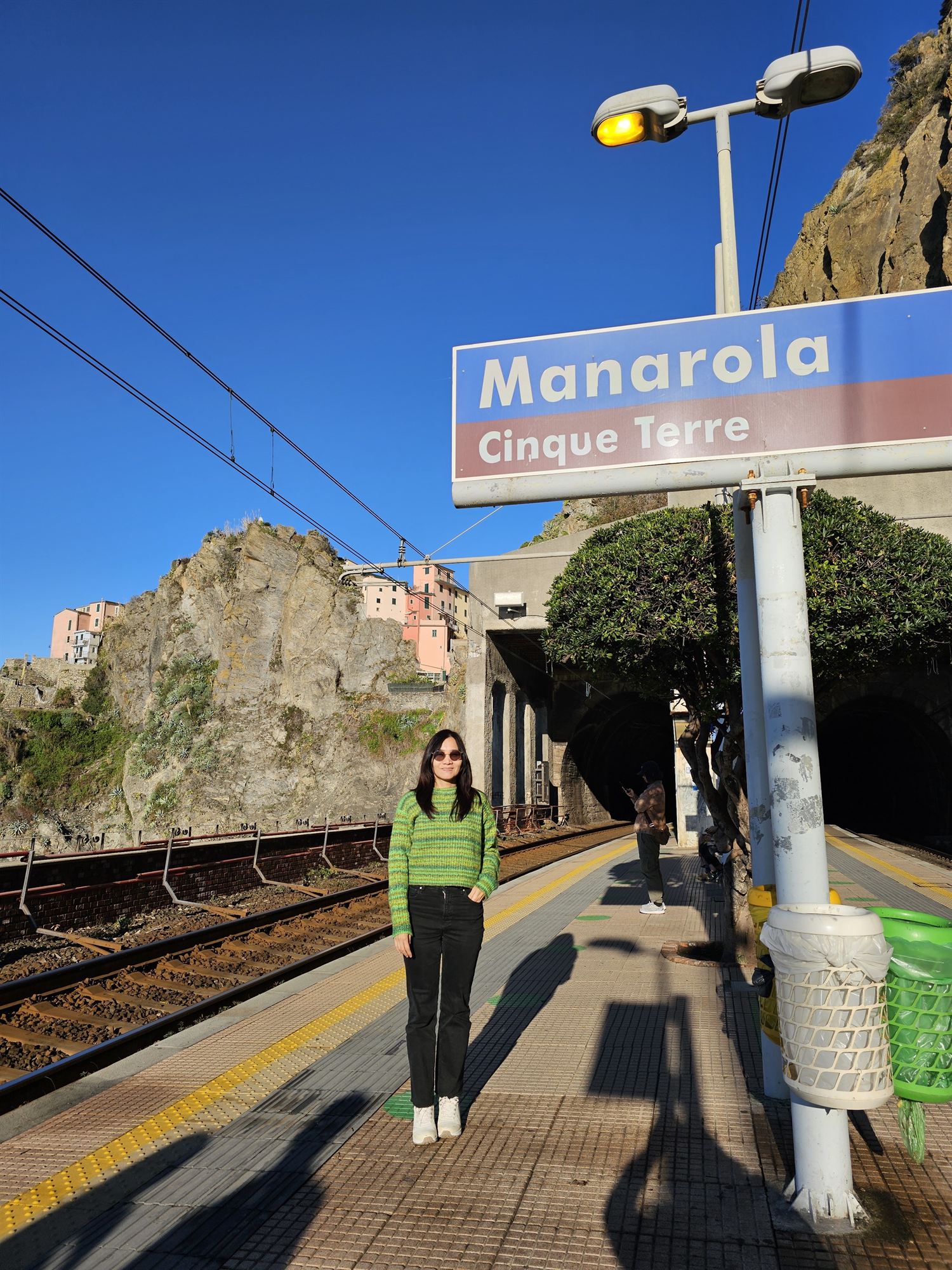 Manarola's station, built into the rock face.
 Manarola's small harbour, by Bar Enrica.
Above the village, a coastal path climbs past terraces of agave and prickly pear toward Punta Bonfiglio, a headland with the best wide-angle view of Manarola's stacked houses — worth the short climb even with tired legs by this point in the day.
Corniglia's Staircase, Vernazza's Harbour
Corniglia is the odd one out: the only one of the five villages not built directly on the water, perched instead on top of a headland roughly 100 metres up. From the train station you can take the shuttle bus or climb the Lardarina, a steep staircase of 377 brick and stone steps that switches back up the hillside. It is a genuine workout, and one reason Corniglia sees noticeably fewer visitors than the other four. From the top, continue through Corniglia along Via Fieschi to the Belvedere di Santa Maria. Vernazza, by contrast, has the only natural harbour in Cinque Terre: a small curved bay ringed by a stone breakwater, with restaurants along the water that make it a good place to stop for lunch.
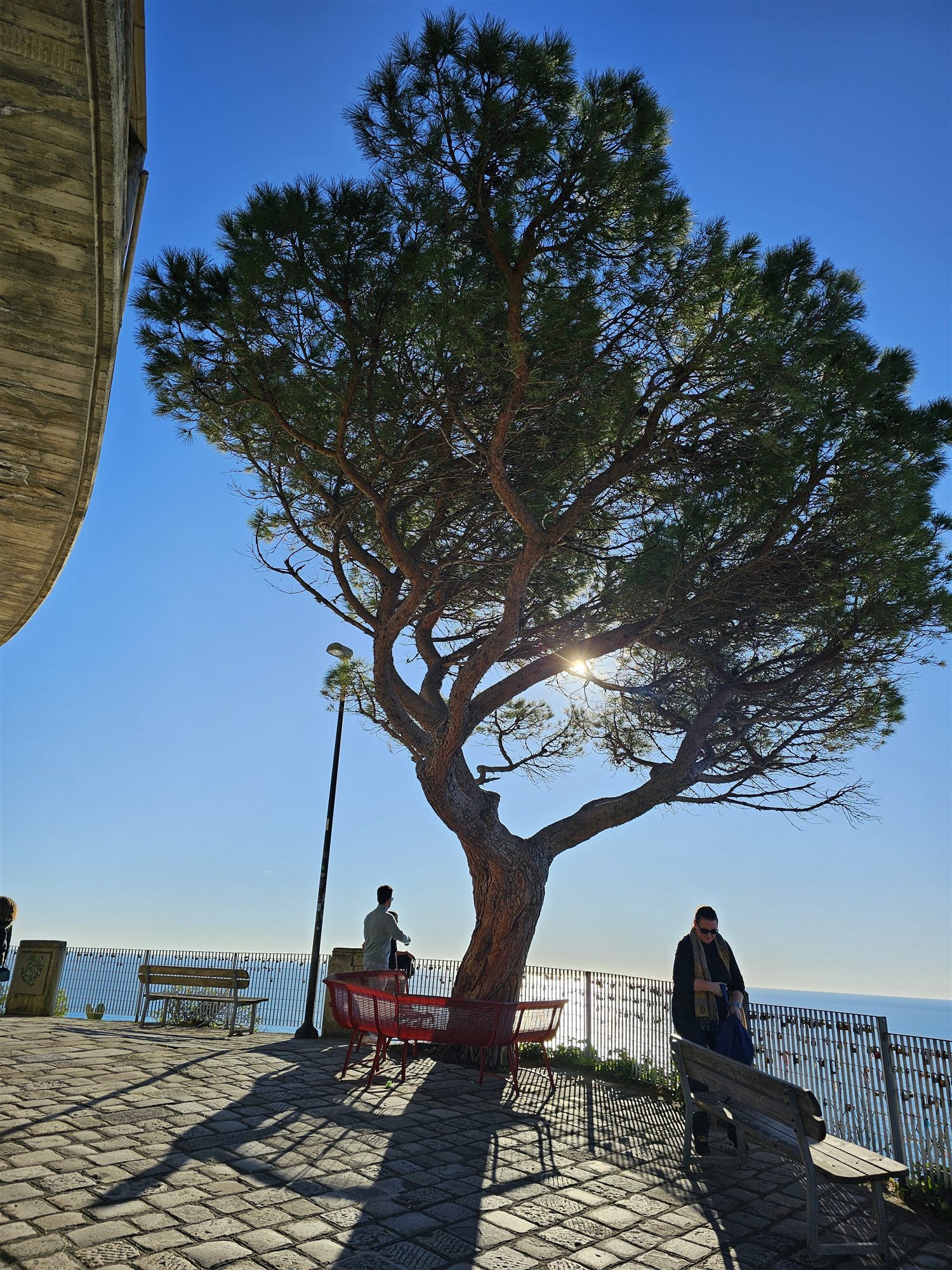 The Belvedere di Santa Maria, at the end of Via Fieschi, with its pine and red bench.
 A gentler stretch of the path, away from the Lardarina steps.
Monterosso and the Coastal Trail
Monterosso al Mare, the largest and most developed of the five, is also the only one with a proper sandy beach rather than a rocky shoreline — and it's exactly why it's popular with families in summer. In December it was close to empty. The historic footpath connecting all five villages, the Sentiero Azzurro or "Blue Trail," runs along this coast in sections; some stretches were walkable on the day, giving good sea views without the steep climbing that closed sections elsewhere on the trail demand. Our daughter spent much of the afternoon crouched on the pebbles, hunting for sea glass, which made the beach the highlight for her. From here we rode the train back south to Riomaggiore for the final stop of the day.

 A quiet moment on Monterosso's beach.
 Monterosso's beach in winter, almost empty.
Riomaggiore: Where We Ended
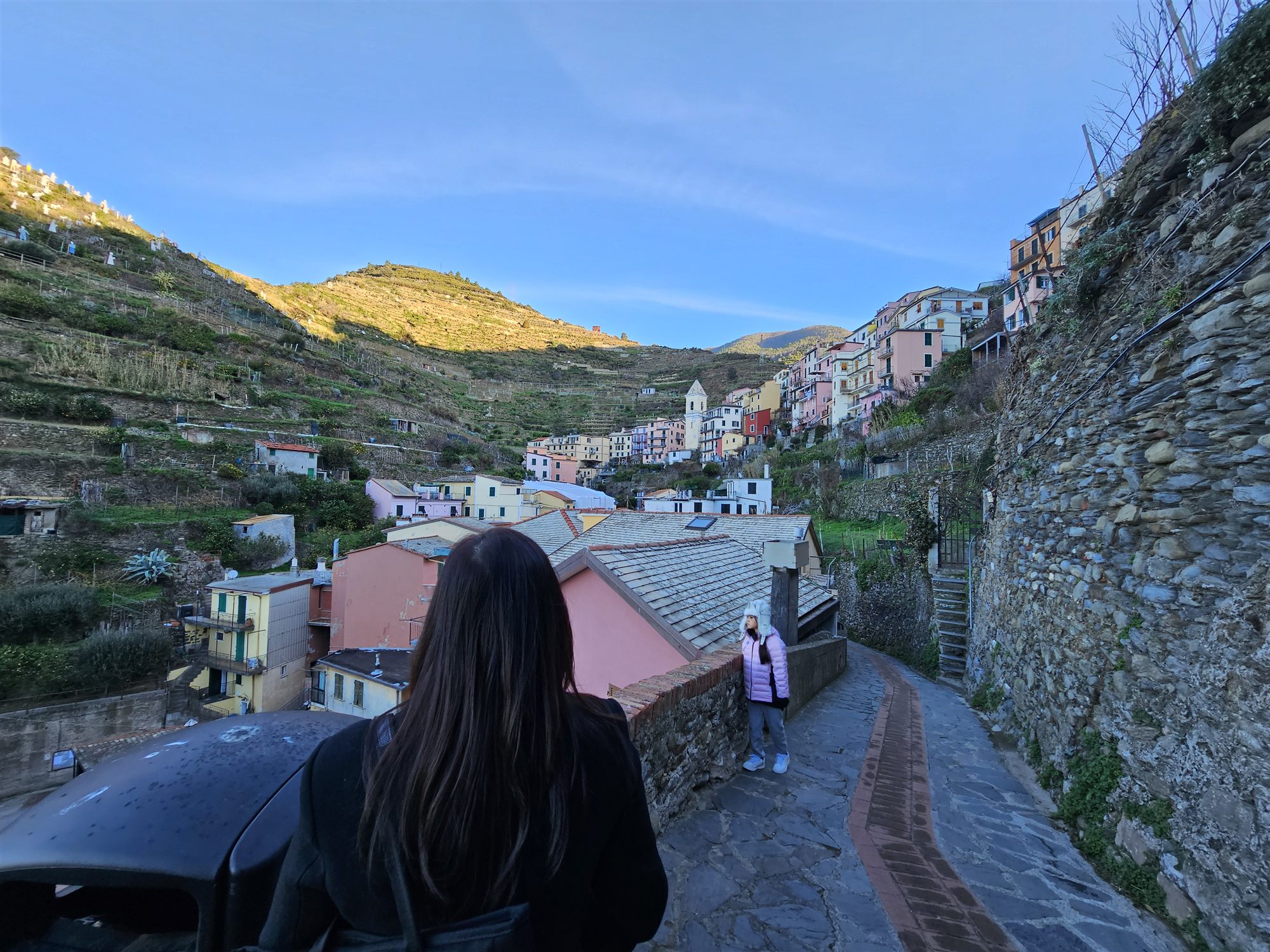
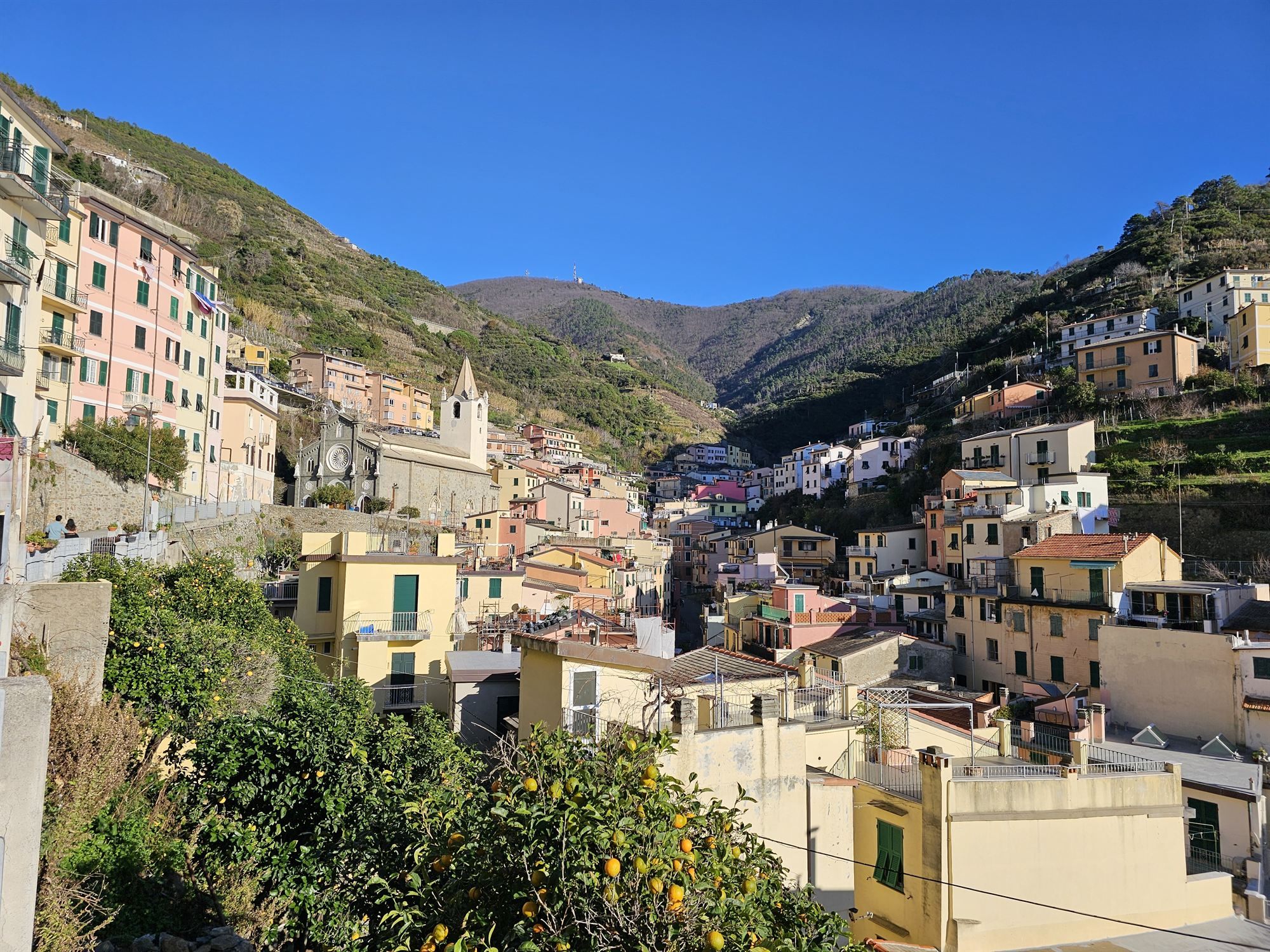
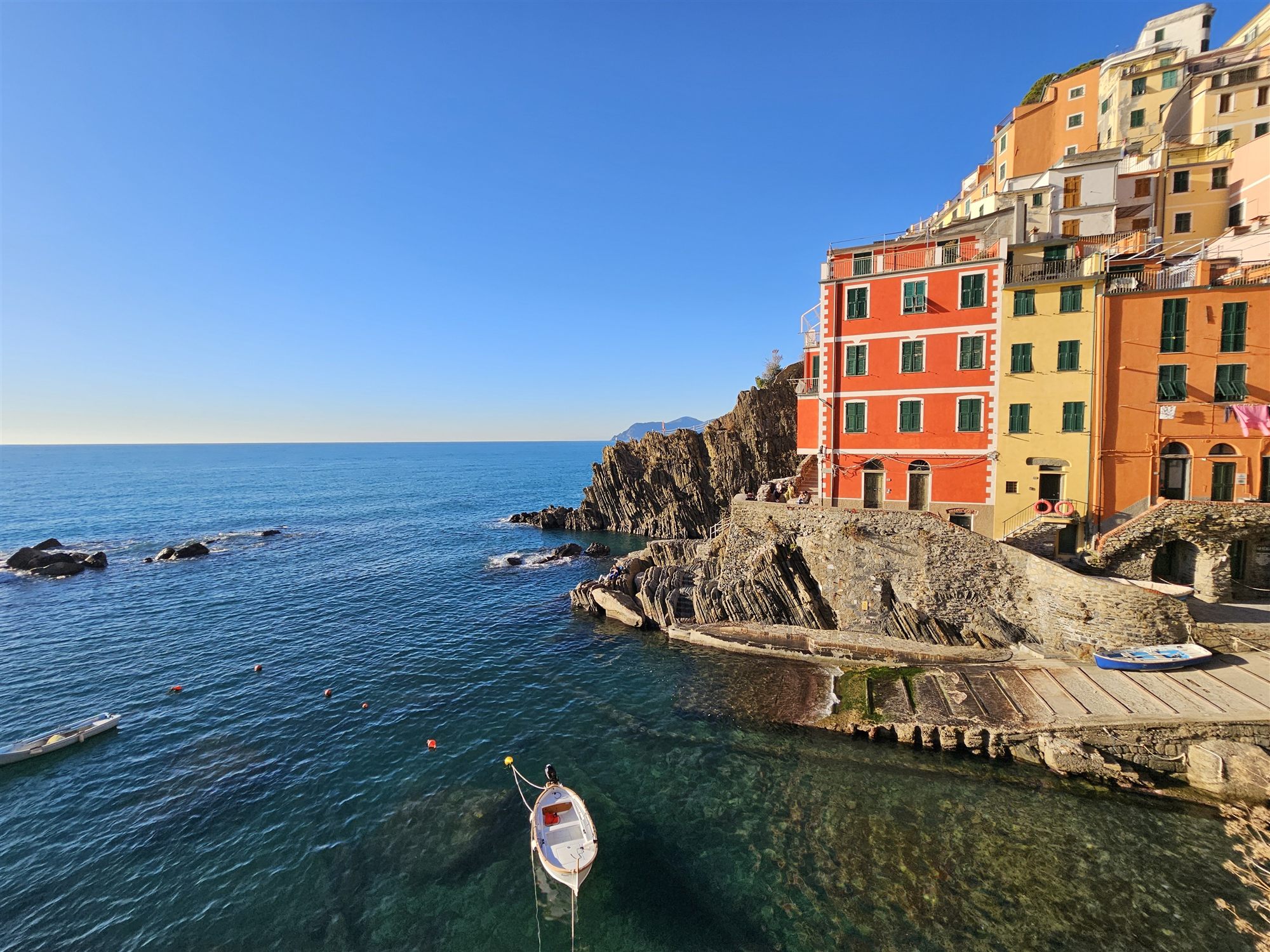
We finished our day at Riomaggiore, the southernmost of the five, its tall, narrow houses stacked in the classic Ligurian palette of ochre, pink and faded red, all facing straight down a ravine toward a tiny harbour. Riomaggiore developed at the mouth of its stream in the 13th century. Local legend traces an earlier hill settlement to Greek refugees fleeing Byzantium, though most of what stands today is considerably more recent, patched and repainted over generations of storms and rockslides.
Wandering the Lanes
Away from the harbour, Riomaggiore is a maze of covered stairways, single-lane alleys, and small stone bridges crossing the stream that runs down to the sea. Most of it is quiet enough in the off-season that you can hear your own footsteps between the buildings.
Planning Your Own Day
If you're doing this as a day trip, buy a Cinque Terre Treno Card in advance — it covers unlimited train travel between the villages for the day and is far simpler than buying individual tickets at each stop. Plan for the trains to be the backbone of your day rather than the trails, especially travelling with kids: hopping a five-minute train between villages is a much easier sell than an hour of cliffside stairs. Visiting in the off-season, as we did in December, means quieter villages and beaches, which gives children real room to move at each stop.