
Quick Facts
- Region
- Bernese Oberland, Switzerland
- Date
- Saturday, 24 December 2022 — Day 5 of 11
- Route
- Interlaken → Grindelwald → Kleine Scheidegg → Jungfraujoch by cogwheel train
- Altitude
- 3,454 metres at the station; 3,571 metres at the Sphinx terrace
- Good for
- A full day — worth doing even if the forecast isn't clear
A Grey Morning
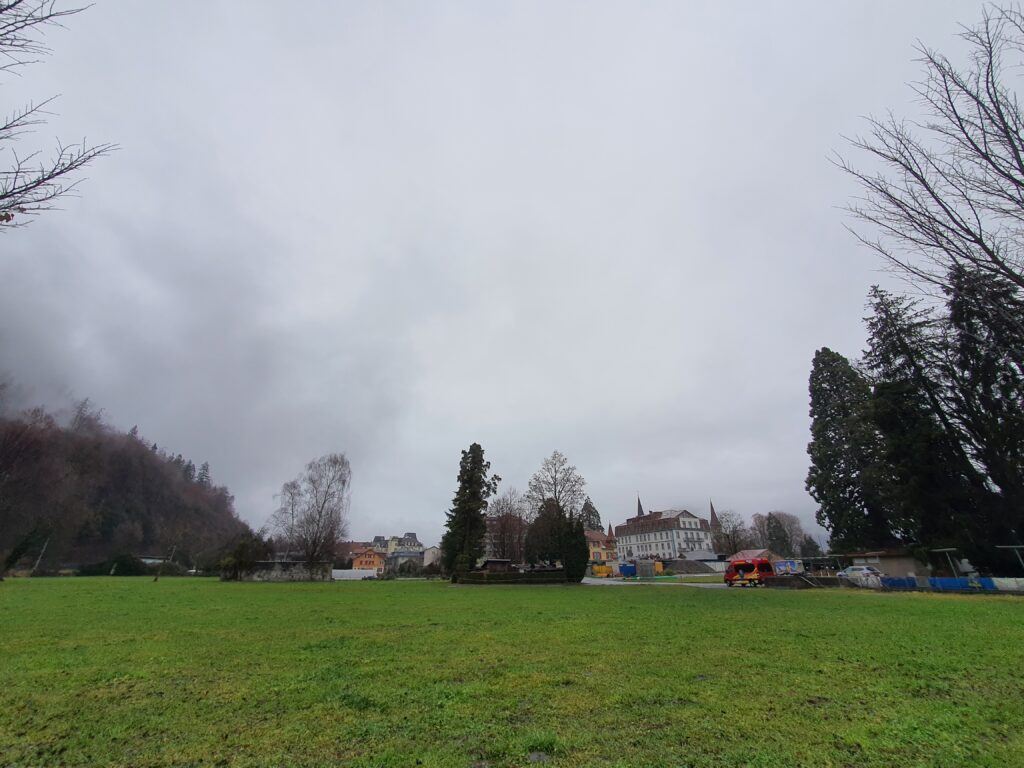
We started the day with breakfast at the hotel, knowing this would be one of the highlights of the trip. The weather wasn't perfect — grey skies and light rain in the valley — but we decided to go ahead anyway. At this altitude, valley weather and summit weather are often two different things entirely.
Through the Bernese Oberland
The coach ride took us through the Bernese Oberland, where the landscape slowly opened into wide valleys and quiet villages. We stopped briefly at Interlaken, whose name comes straight from its position between Lake Thun and Lake Brienz — inter lacus, Latin for "between the lakes." Even in the rain, it had that postcard feel: quiet streets and mountain views hidden behind cloud, before the real climb began.
The Climb to Jungfraujoch
From Grindelwald, we boarded the Jungfrau Railway, a cogwheel line first proposed in 1893 by the Zürich industrialist Adolf Guyer-Zeller. It took 16 years to build, largely because more than half the route runs through tunnels blasted directly through the rock of the Eiger and the Mönch — a project that cost several workers their lives before it finally reached the summit station in 1912. It remains the highest railway station in Europe.
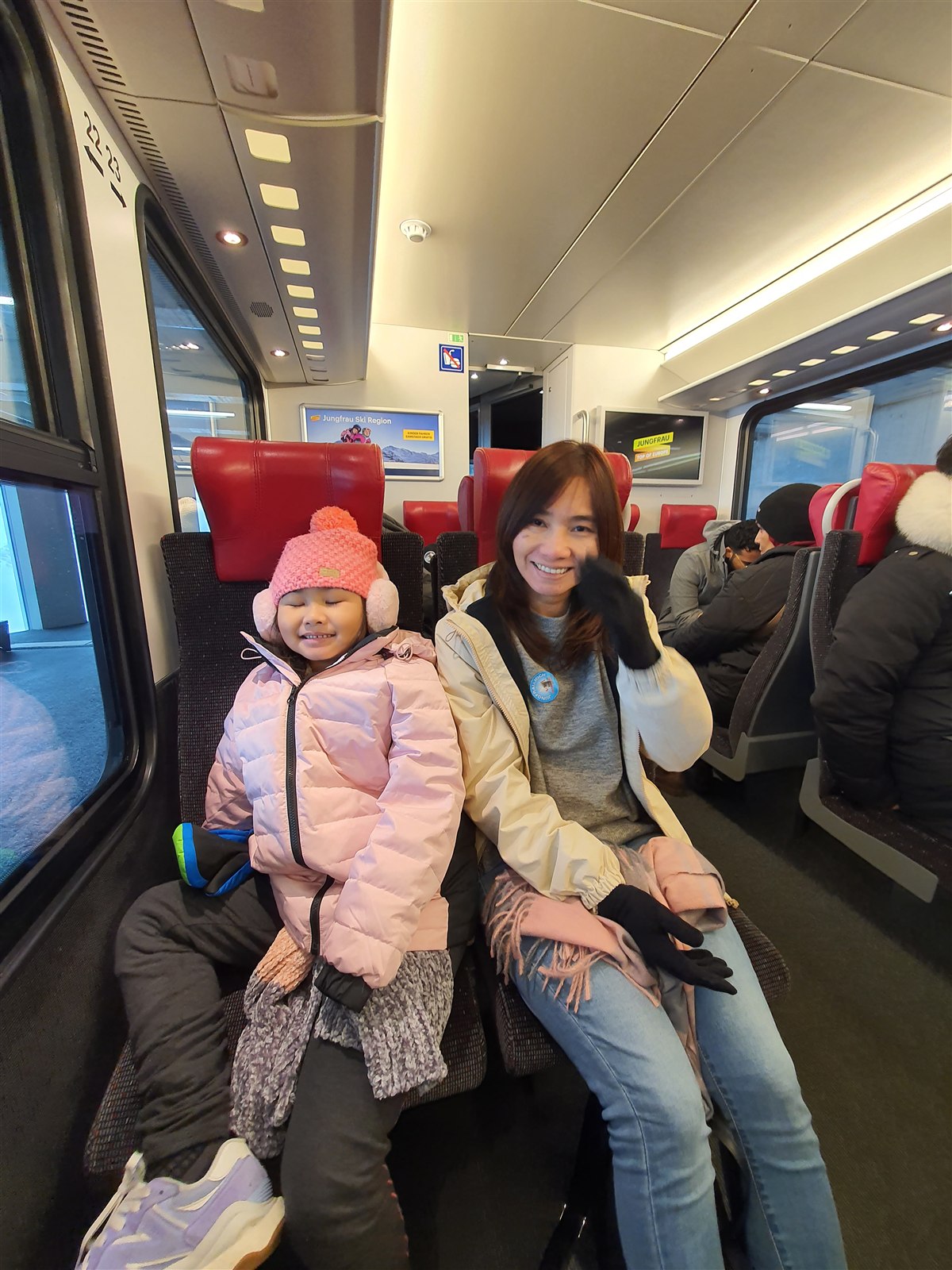 Settling into our seats on the Jungfrau Railway.
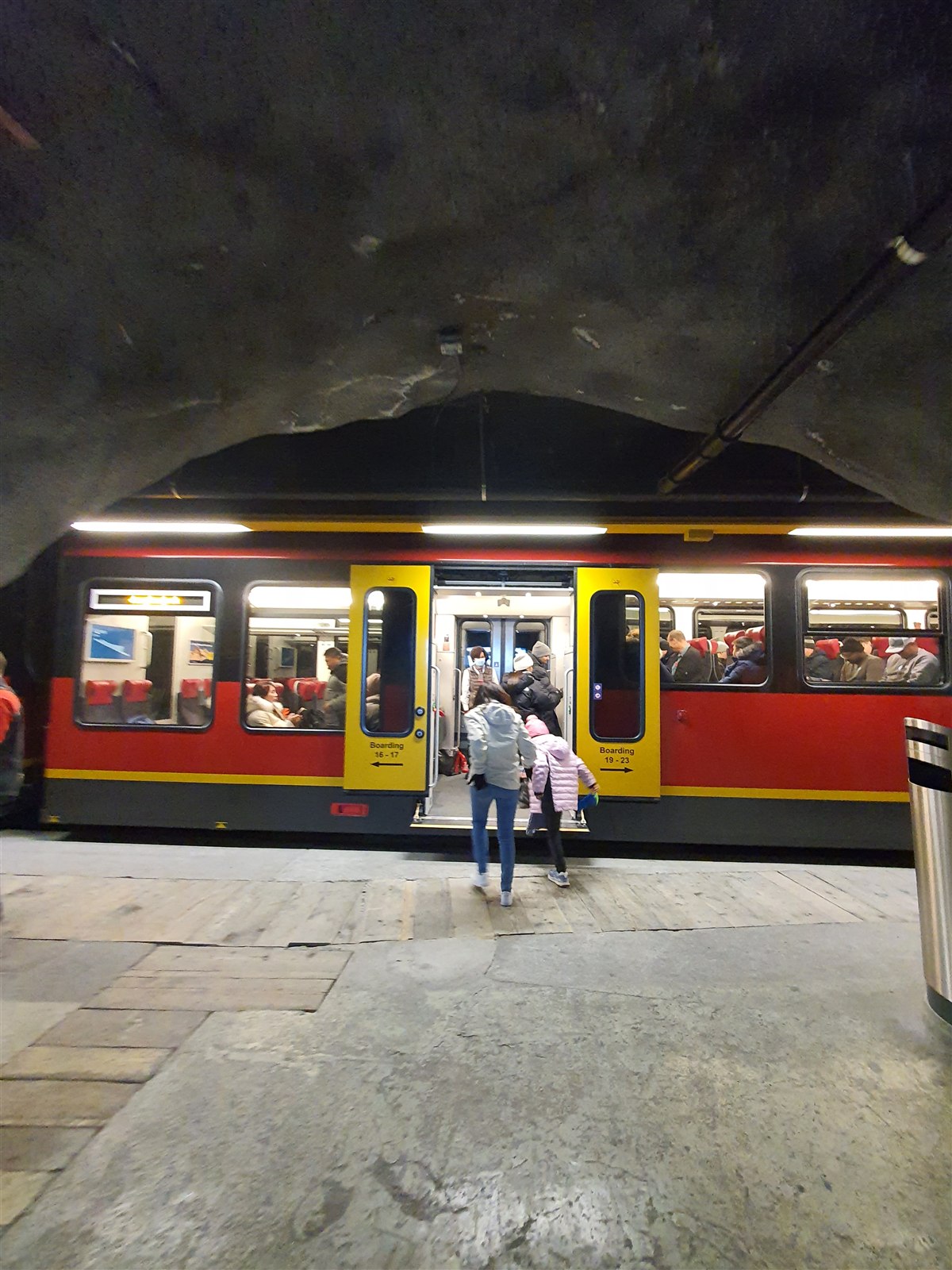 Boarding at the tunnel platform, with the train already full.
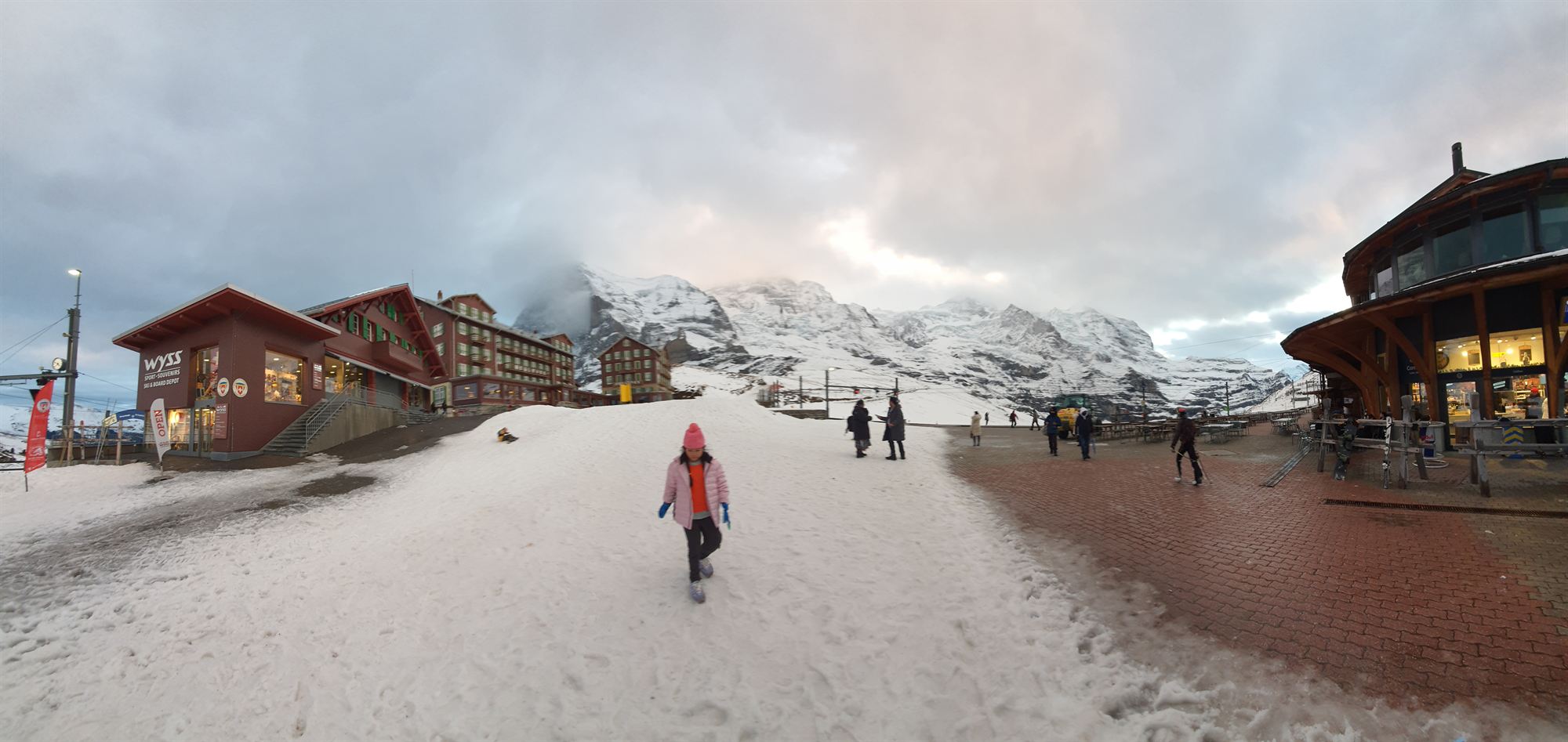
The train stops partway up at Eigergletscher, at 2,320 metres, right at the foot of the Eiger's glacier and a launch point for skiers and snowboarders heading back down. Before that, most trains change at Kleine Scheidegg, a mountain pass at 2,061 metres directly beneath the Eiger's infamous North Face — the wall that claimed the lives of several climbers in the 1930s before it was finally climbed in 1938, watched at the time through telescopes from the terrace of the Bellevue des Alpes hotel that still stands there today.

Don't let a grey forecast put you off — the climb and the Ice Palace are worth it regardless of visibility, and clouds at the peaks can clear unexpectedly. Dress for well below freezing no matter what the valley weather looks like, and book train tickets in advance in peak season, as capacity up the mountain is limited.
At the Top — A World of Ice and Snow
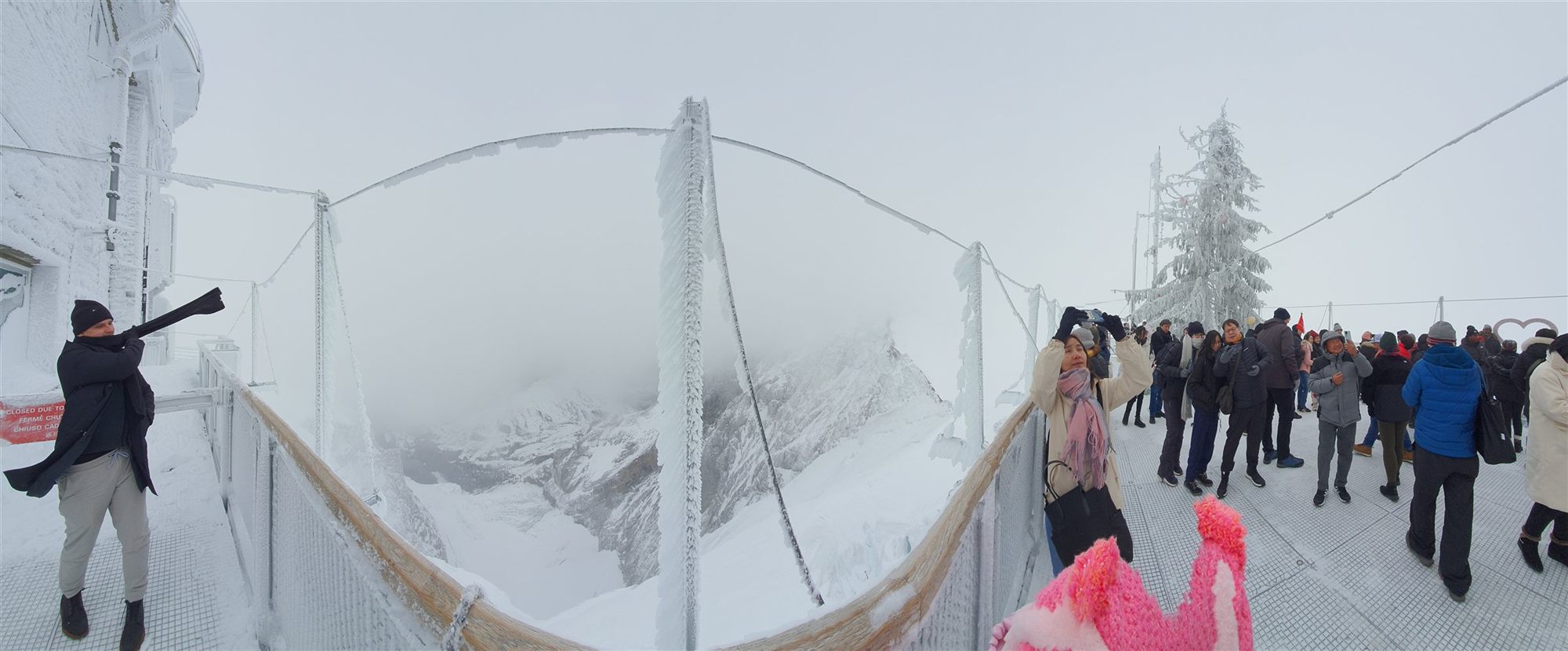
At Jungfraujoch, snow stretched in every direction, blending into the sky. We climbed up to the Sphinx Observation Terrace at 3,571 metres, reached by Europe's fastest elevator, built into the rock in the 1930s alongside the Sphinx Observatory — a high-altitude research station that has been used for meteorology and astronomy since 1937. On a clear stretch, the view opens onto the Aletsch Glacier, at around 22 kilometres the longest glacier in the Alps and, together with the surrounding peaks, part of a UNESCO World Heritage Site since 2001.
Inside the Ice
One of the most memorable parts was walking through the Ice Palace, a network of tunnels and chambers cut directly into the glacier. Mountain guides first carved it out in 1934, and because the glacier ice is constantly shifting and slowly melting from the inside, the tunnels have to be re-carved and maintained every year just to stay open. Everything around us was ice — floors, walls, sculptures, glowing softly under the lights.
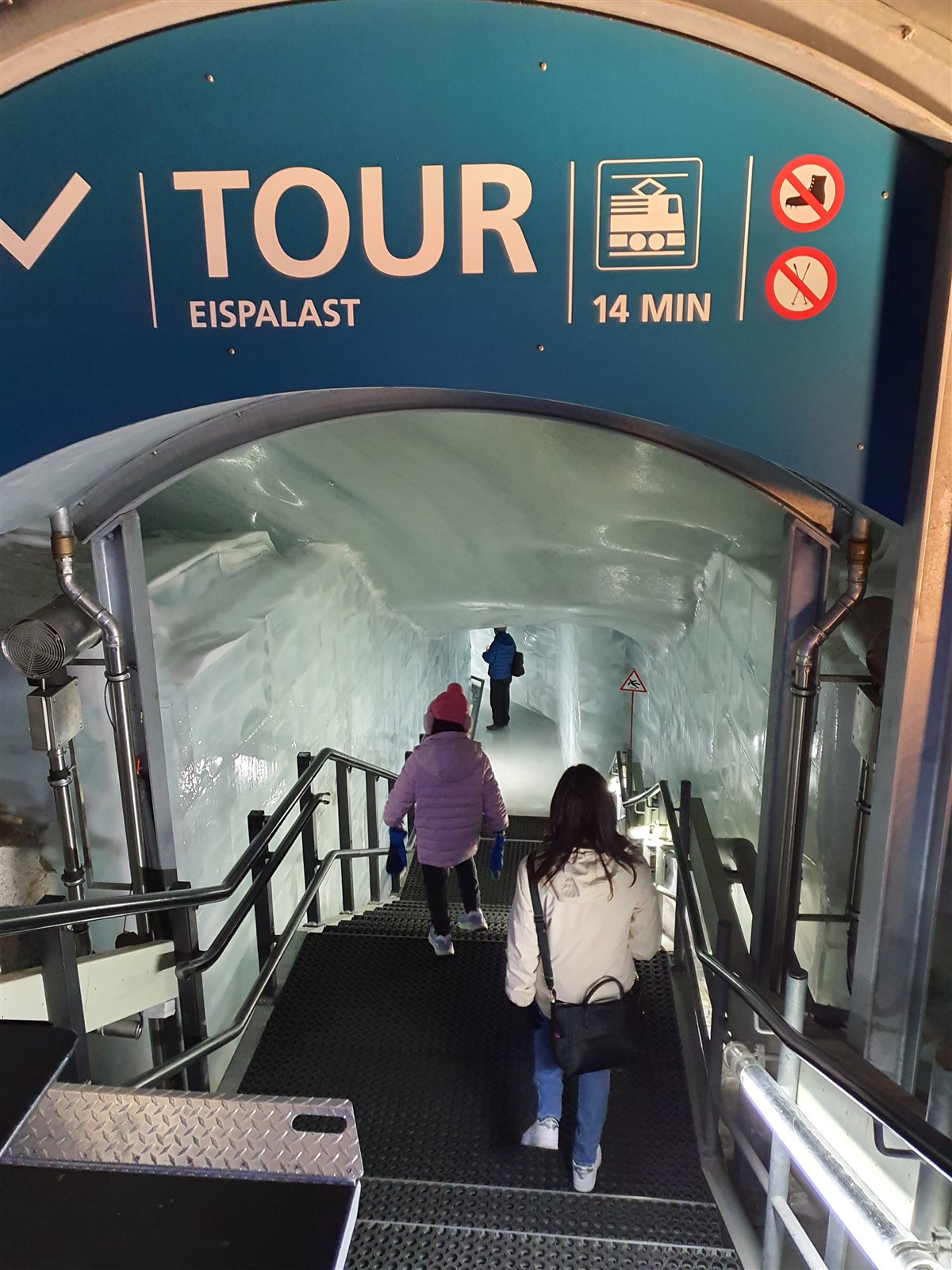 The stairs down to the Eispalast, with the 14-minute tour sign above.
 Walking the ice tunnel, past carved penguins and an igloo.
Small Moments Along the Way
Between the sights and the stops, it was the smaller moments that made the day feel complete — a quick selfie squeezed in between attractions, our girl playing in the snow without a second thought for the altitude or the cold.
 Playing in the snow in front of the Hotel Bellevue.
 The three of us in front of the Hotel Bellevue.
The Journey Back Down
As we made our way down, the landscape shifted again, snow slowly giving way to valleys and villages, the light turning gold as the afternoon wore on. We passed through places like Wengen and Lauterbrunnen, quiet and peaceful, before returning to where the day had begun.
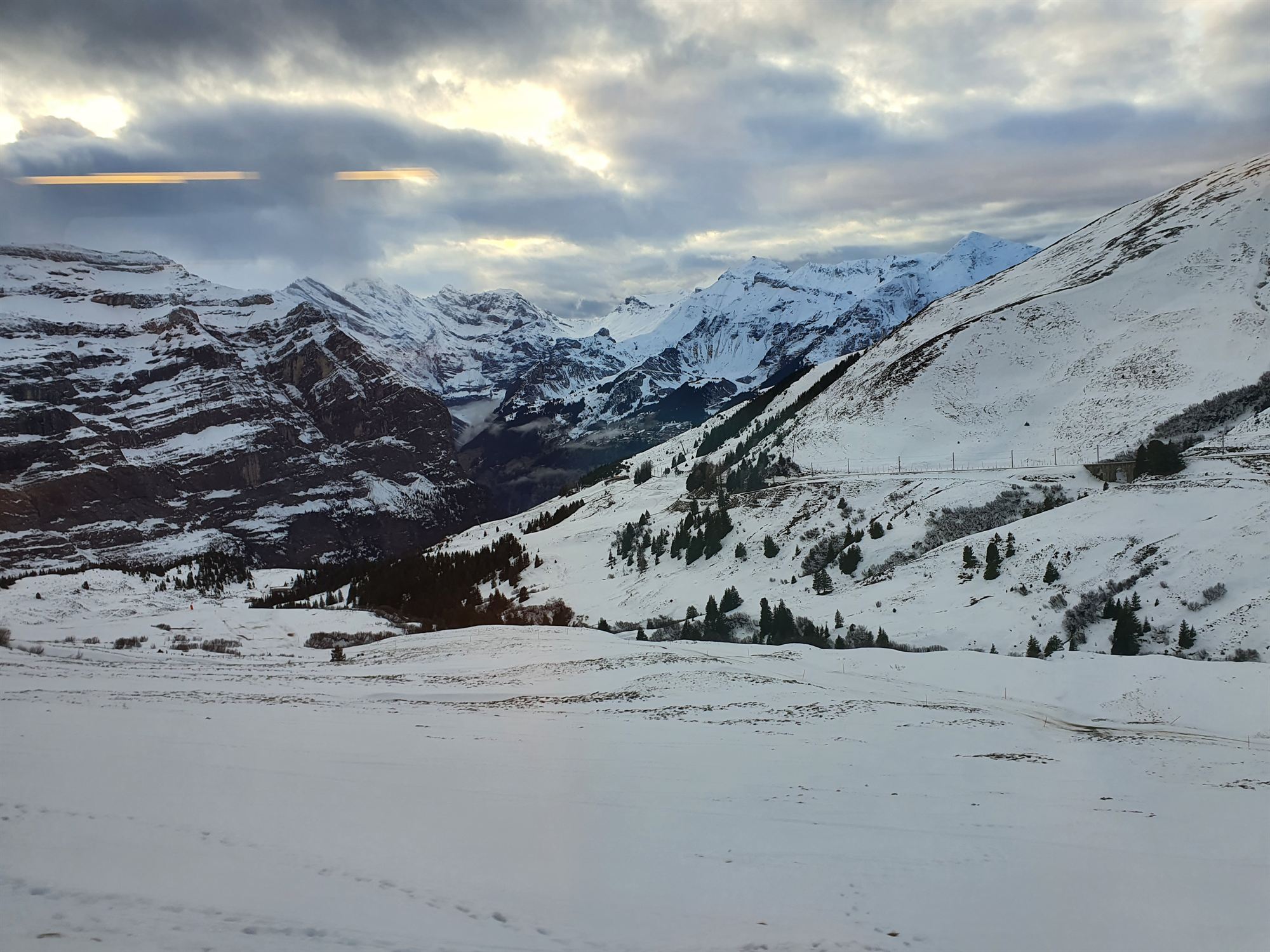
It wasn't a perfectly clear day, but it didn't need to be. Jungfraujoch isn't only about the view — it's a 1912 engineering feat through solid rock, a glacier you can walk inside, and a research station sitting above 3,500 metres, all reachable in half a day from the valley floor.