
Quick Facts
- Date
- Tuesday, 19 December 2023 — Day 9 of 14
- Tour
- Private guided walking tour, half-day, led by a national guide (ours was Manuel Reina, a historian and Florence native)
- Region
- Florence, Tuscany, Italy
- Covers
- Galleria dell'Accademia, the Duomo, Piazza della Signoria, Bargello Museum, Ponte Vecchio
- Good for
- A guided walking day — book a private guide if you can, it changes the whole visit
Arriving With a Guide, Not Just a Map
We caught the train from Naples that morning and were in Florence by midday, where we met our guide for the afternoon: Manuel Reina, a licensed national guide and Florence native with a genuine background in art history. Florence rewards this kind of guiding more than most cities — half of what's worth seeing is a story you'd otherwise walk straight past.
Michelangelo's David at the Accademia
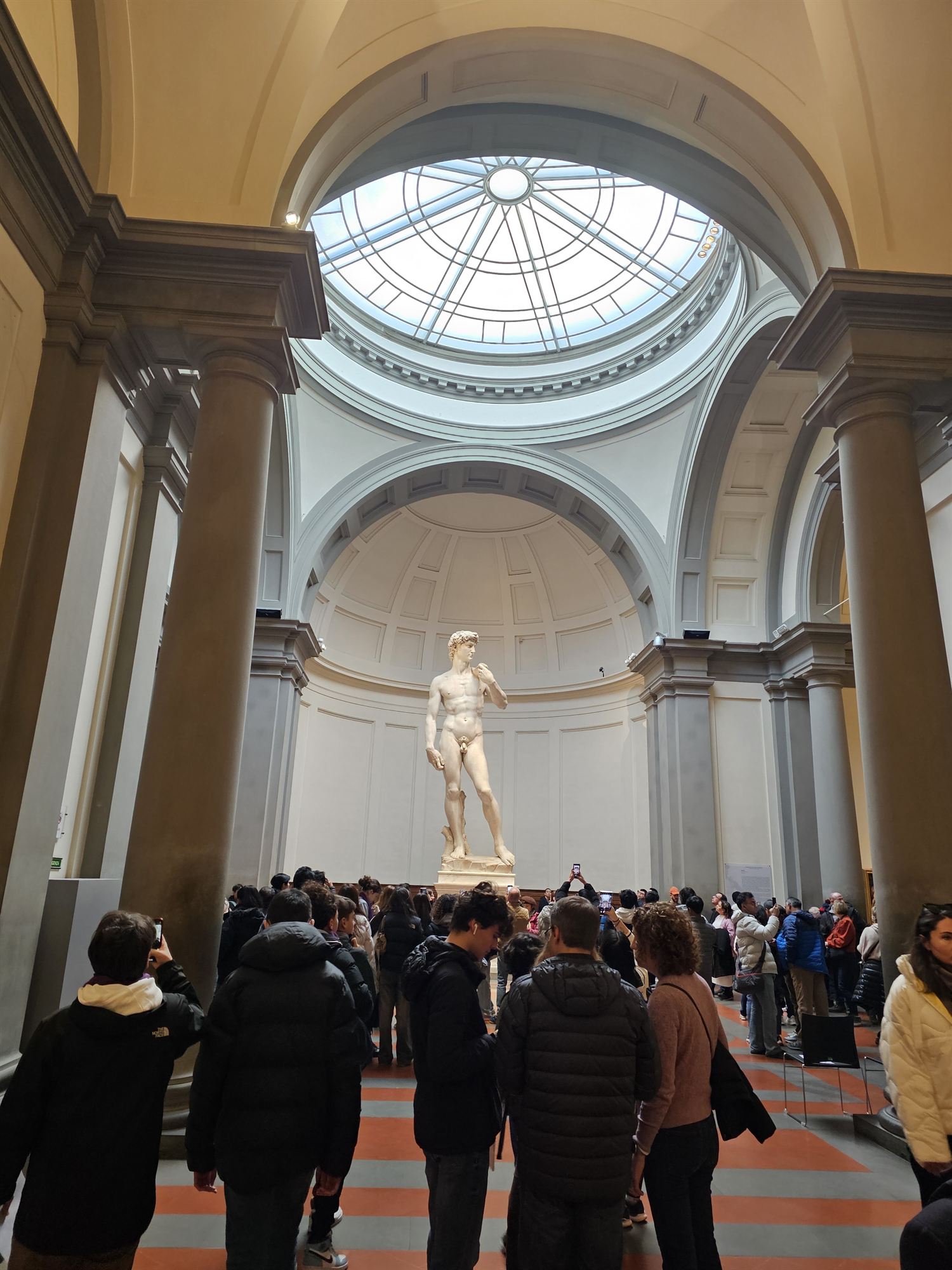
Our first stop was the Galleria dell'Accademia, built specifically to house Michelangelo's David after it was moved indoors in 1873 to protect it from weather damage. The approach to the statue is deliberately staged: a long corridor lined with Michelangelo's unfinished "Prisoners" sculptures, figures left half-emerged from their marble blocks, leads directly toward David standing under a skylight at the far end.
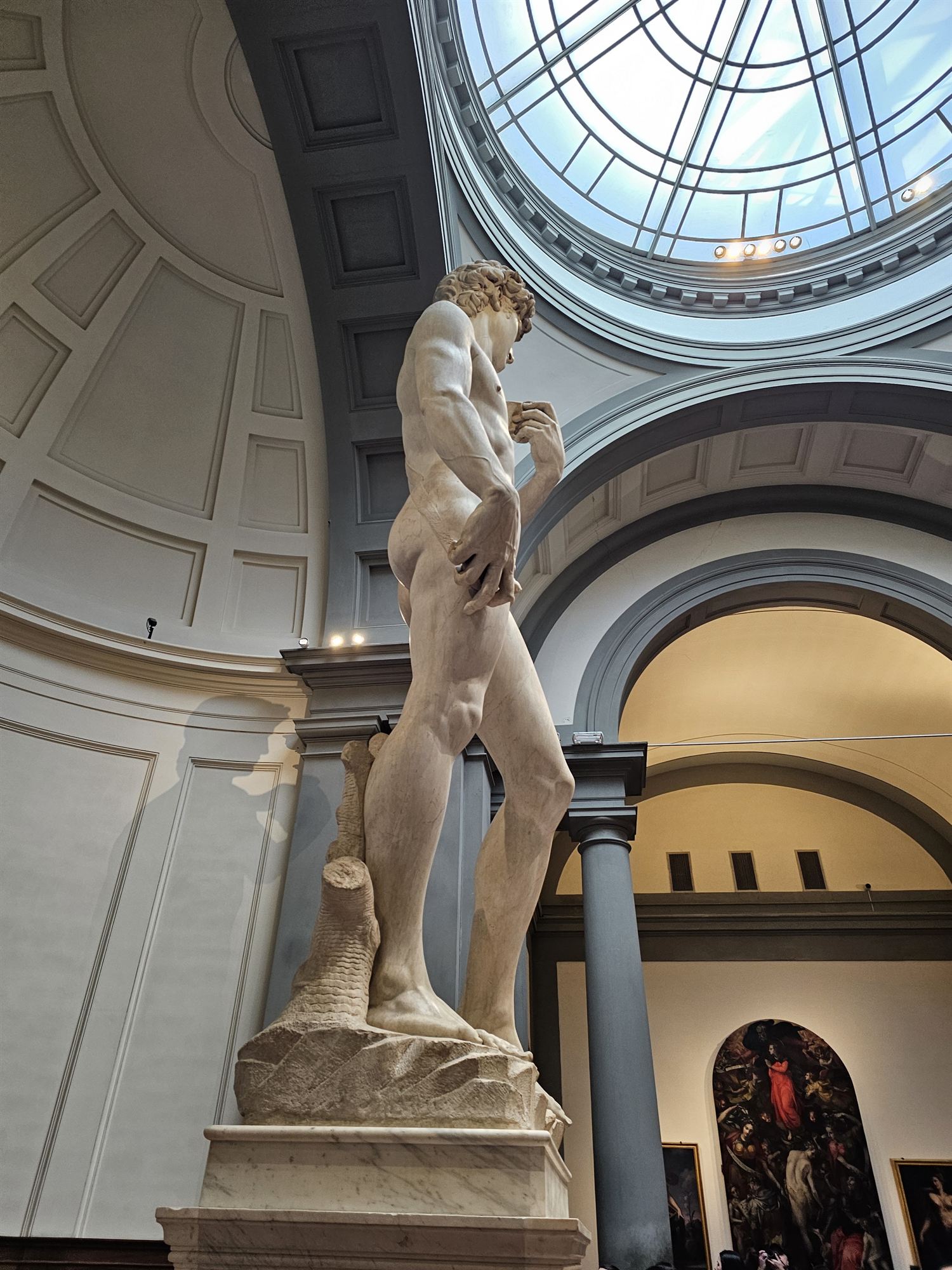
David himself was carved between 1501 and 1504 from a single 5.17-metre block of Carrara marble that two other sculptors had already tried and abandoned decades earlier, considering it too flawed to work with. Michelangelo was 26 when he started. The statue was originally meant to stand on the roofline of Florence Cathedral, but once finished, city officials decided it was too good for a rooftop and placed it instead outside the Palazzo Vecchio, where a full-size replica still stands today. Our guide pointed out a detail we'd have missed alone: David's right hand, holding the sling, is noticeably larger than proportion would suggest — a deliberate choice symbolising the strength about to be used against Goliath.
The Duomo and Brunelleschi's Impossible Dome
From the Accademia we walked to the Cathedral of Santa Maria del Fiore, Florence's Duomo. The building was started in 1296, but for well over a century it sat with a gaping hole where the dome should be — nobody knew how to build one that large without it collapsing under its own weight. Filippo Brunelleschi solved it in the 1420s with a self-supporting double-shell design and a herringbone brick pattern that needed no wooden scaffolding from the ground up, an engineering solution that had no precedent at the time and still hasn't been fully explained by modern engineers reconstructing his methods. The dome was completed in 1436 and remains the largest brick dome ever built. Up close, the marble façade in white, green and pink is a 19th-century addition, added centuries after the dome itself — the original medieval front had been left unfinished and was torn down in the 1580s.
A private guide who can explain the stories behind the statues makes a genuine difference with kids — Piazza della Signoria's statues go from "just sculptures" to something worth stopping for once you know that one of them marks the spot where a Renaissance monk was burned at the stake.
Piazza della Signoria: Florence's Political Stage
Piazza della Signoria has been the seat of Florence's civic government since the 14th century, and it's also where the reformist friar Girolamo Savonarola was executed and burned in 1498, after briefly ruling the city and famously staging the "Bonfire of the Vanities" — a mass burning of art, books, and mirrors he considered sinful, in the very same square. A bronze plaque set into the paving marks the exact spot today. Among the statues standing guard, Benvenuto Cellini's bronze Perseus, holding the severed head of Medusa, was cast in 1554 and remains one of the finest bronze castings of the Renaissance.
Beside Piazza della Signoria sits the Loggia dei Lanzi, an open-air gallery of sculpture built in the 1380s, where Cellini's Perseus stands alongside a Roman-era Hercules and a fountain — effectively a free outdoor museum you can walk through any time of day.
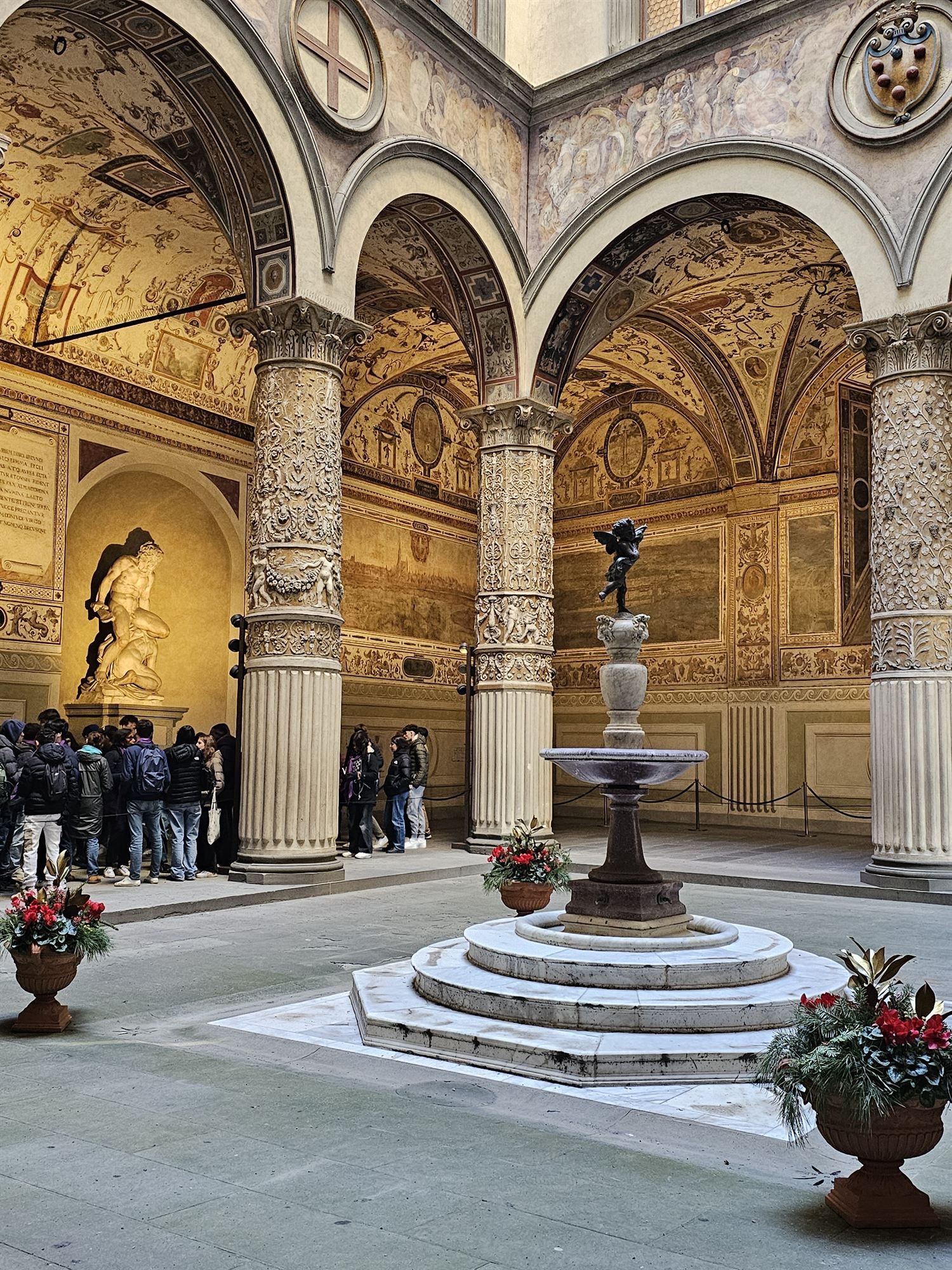
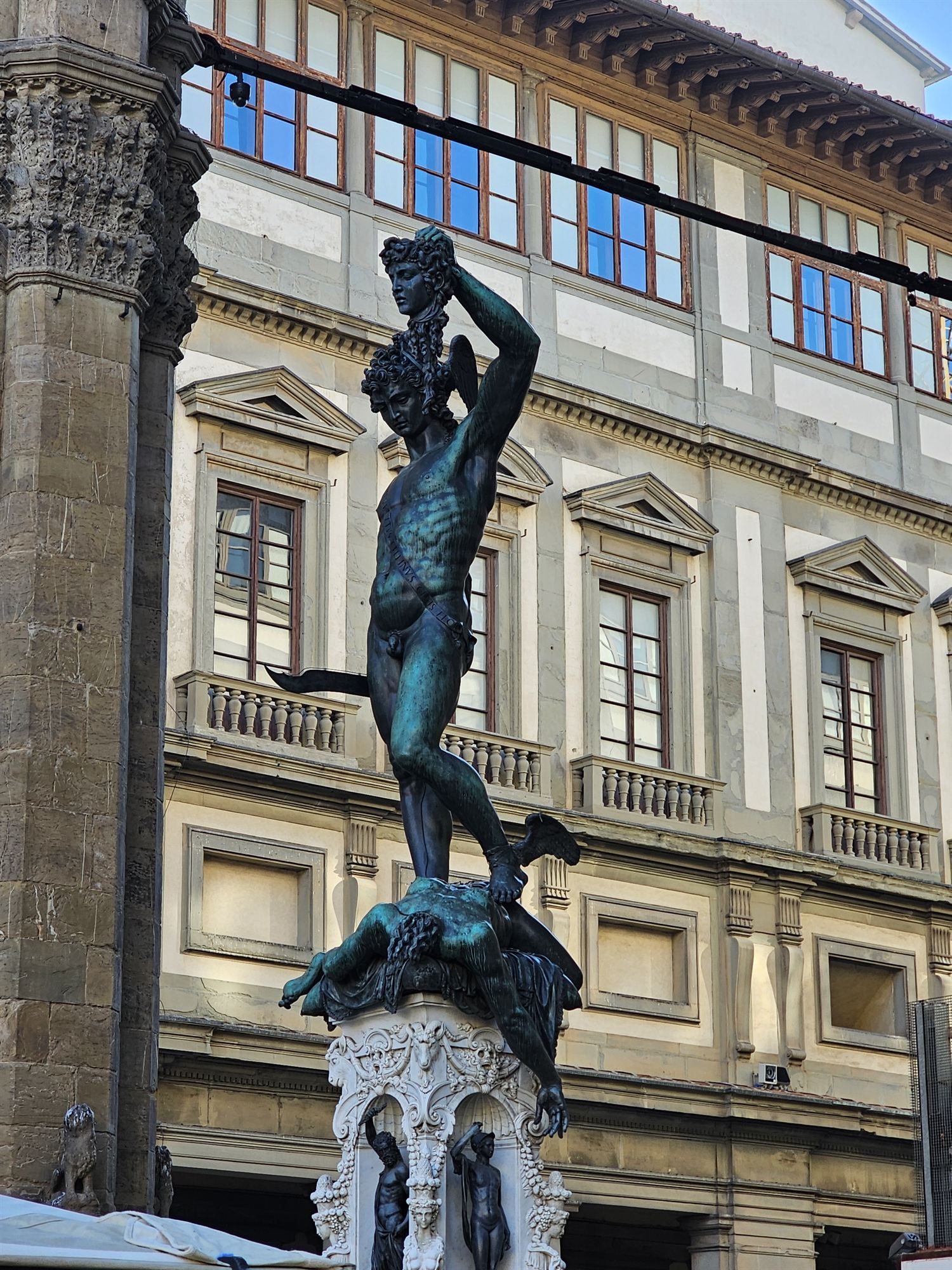
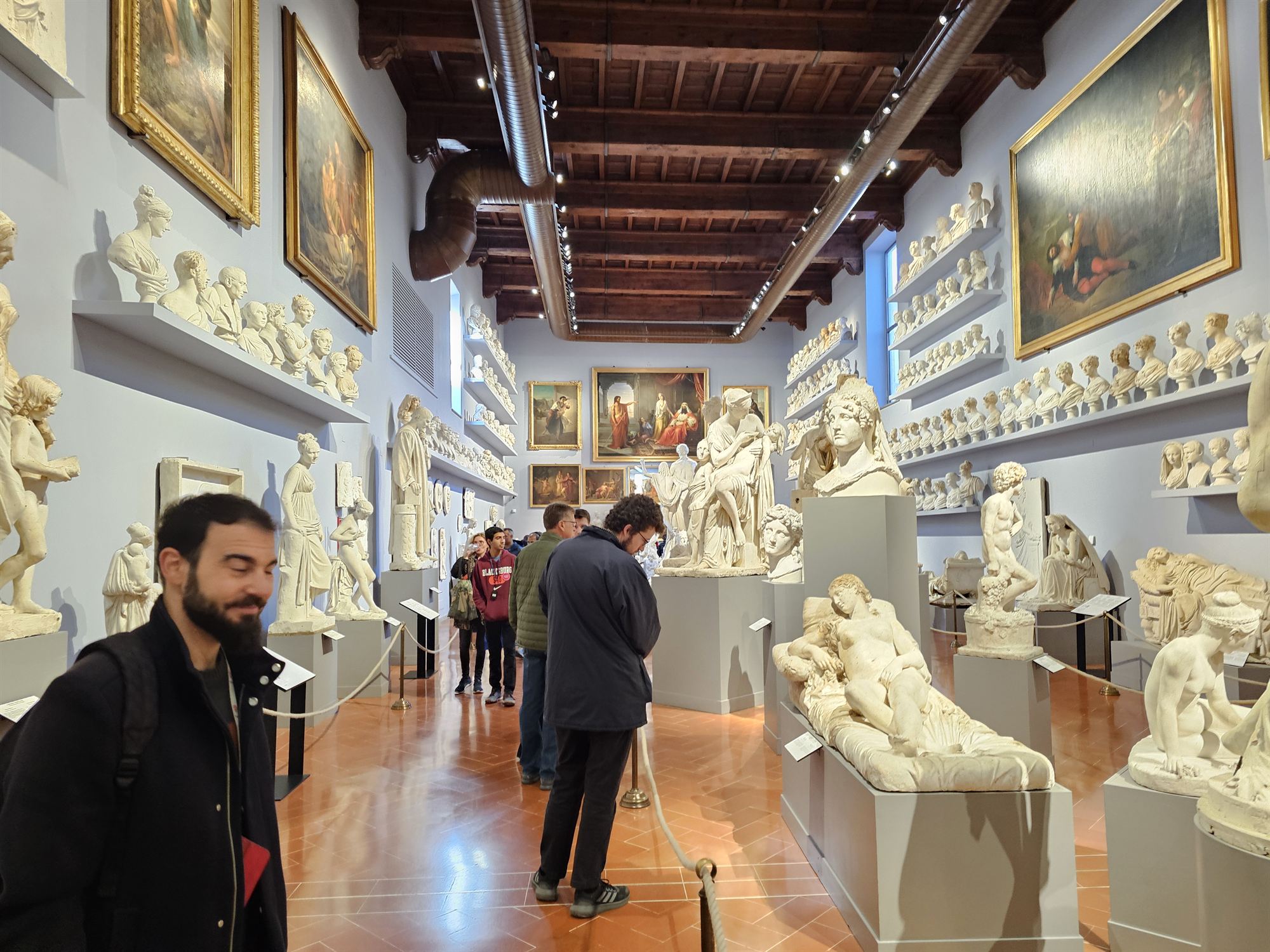
From there we also visited the Bargello, Florence's former town hall and, later, a prison and place of execution, now a museum holding some of Donatello's most important sculptures, including his bronze David — a very different, far more delicate take on the same Biblical figure than Michelangelo's version. Rooms of plaster casts and classical busts line its upper galleries, a quieter counterpoint to the crowds at the Accademia.
Ponte Vecchio: The Bridge Florence Kept
We walked toward the river through the narrow shopping streets of the old town, restaurant flags hanging overhead, before reaching the Ponte Vecchio, Florence's oldest bridge and the only one in the city to survive the Second World War.
 The narrow streets leading toward the Ponte Vecchio.
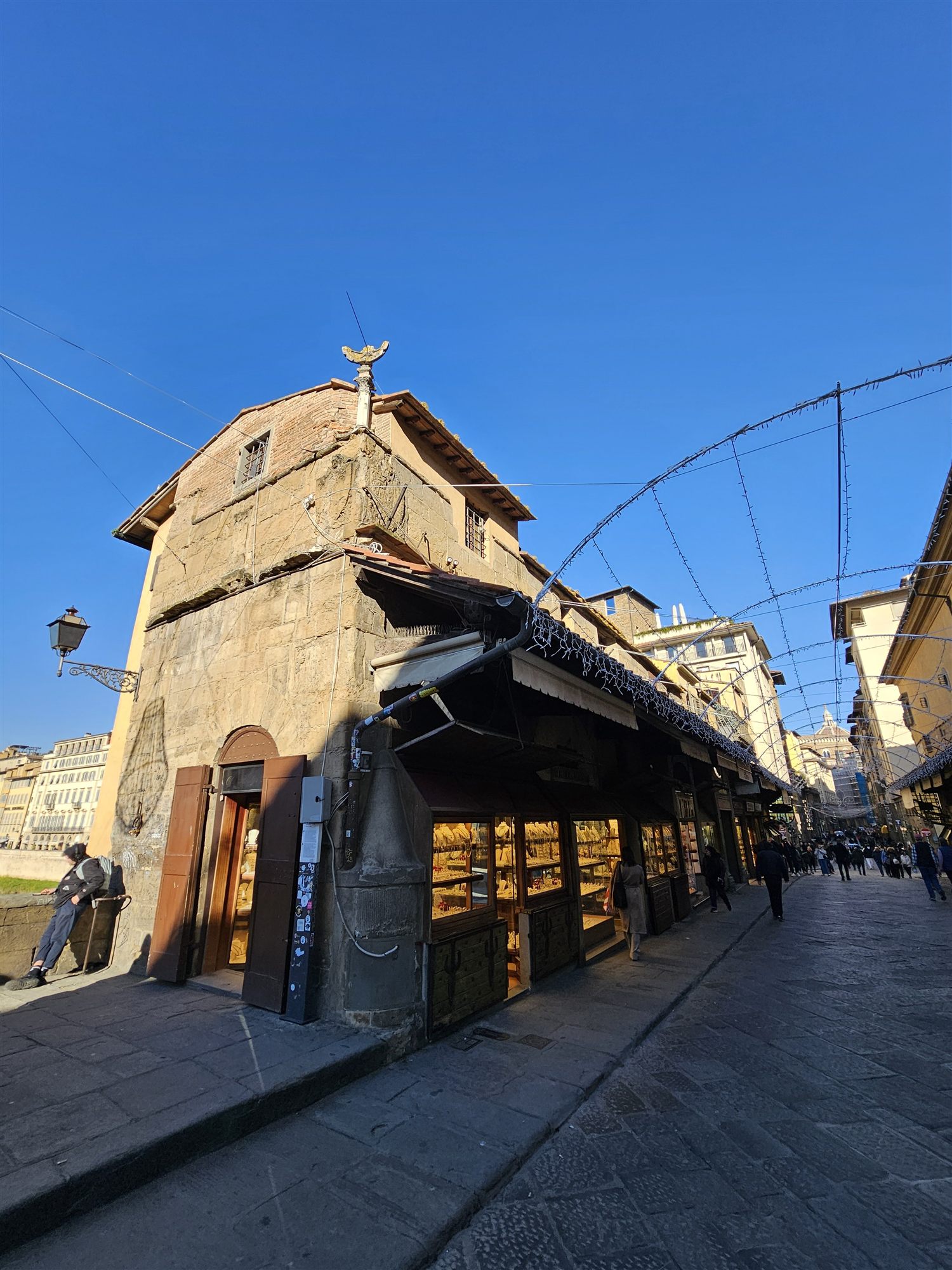 The jewellers' shops built along the Ponte Vecchio.
In August 1944, retreating German forces destroyed every other bridge across the Arno to slow the Allied advance; the Ponte Vecchio was reportedly spared on direct order, though historians still debate exactly why. The shops lining it have sold jewellery since 1593, when Grand Duke Ferdinando I de' Medici evicted the butchers who'd occupied it for centuries, reportedly because he was tired of the smell drifting up to the private corridor he'd built directly above the shops.
Ending on Gelato
We closed the day the way most days in Italy should end: with gelato, sitting near the Arno while the light went gold over the water. Between the David, a five-century-old bridge and a dome nobody could explain how to build, it was a lot of history for one afternoon — but it's easier to absorb with a good guide doing the explaining.